How Ploutos AI analyzes a stock in 4 stages (and one Devil's Advocate)
From screening to bear-case stress test, the full pipeline that runs every time you submit a ticker, explained without jargon.
Research, not advice. This guide is educational. It explains a methodology and is not a recommendation to buy or sell any security. Full disclosure at the end.
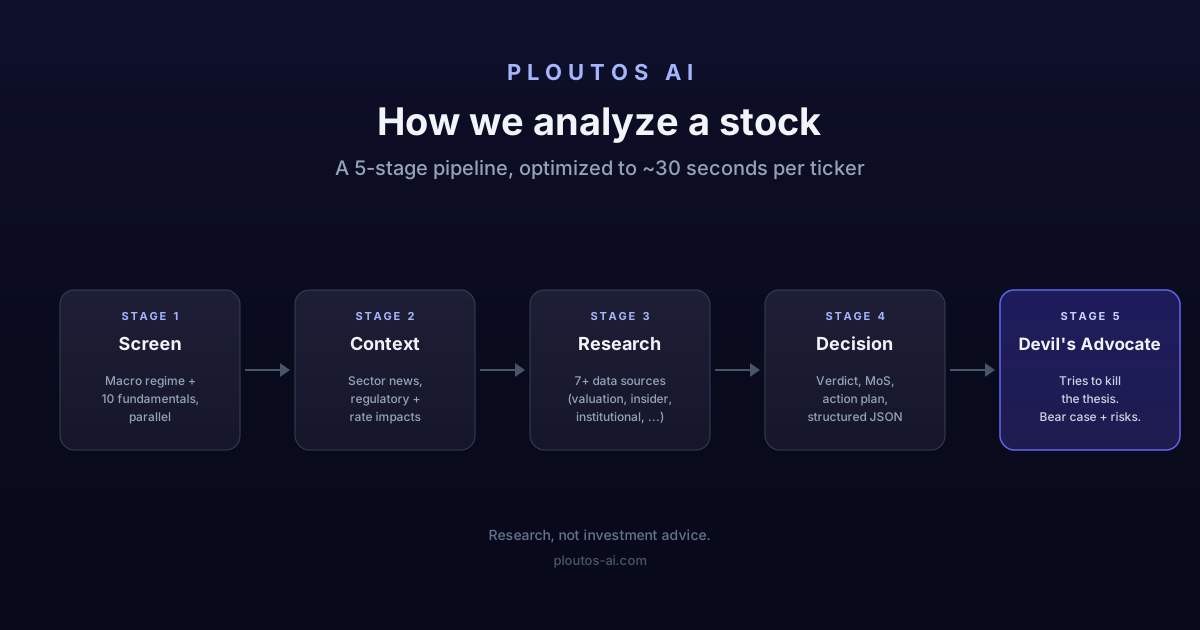
Most tools that promise "AI stock analysis" do roughly the same thing. They paste your ticker into a large language model and hand you back whatever comes out. It looks smart. It reads like a research report. And often, when you look closely, the numbers are made up, the cited sources don't exist, and the conclusion contradicts a sentence written three paragraphs earlier.
Ploutos AI is built around the opposite assumption: a language model alone is not a research analyst. It needs structure, real data, and (most importantly) something to push back against its own conclusion. That is why every analysis you run goes through the same five stages, in the same order, with the same discipline. This article walks through what is happening behind the spinner.
Why a pipeline instead of one big prompt
A single LLM call has two failure modes that are hard to fix from inside the prompt:
- It hallucinates specifics: a P/E ratio that does not match reality, an insider transaction that never happened, a sector rotation that ended last quarter.
- It confirms its own thesis: once it has written "the case for buy" in paragraph one, paragraph four will rarely call it wrong.
Splitting the work into stages, with each stage given a narrow job and each grounded in actual data fetched live from the public-domain stack we ship today (SEC EDGAR XBRL for fundamentals, FRED for macro and FX, FINRA for short interest, Marketaux for news), addresses the first problem. A separate, hostile critique pass at the end addresses the second. Below are the five stages in order.
Stage 1: Screen (macro regime + fundamentals)
The first thing the agent does is fire two calls in parallel:
- Macro regime check: current VIX level, yield curve, market trend, central bank stance. This shapes how every later decision is weighted (a stock that scores well in a bull market scores differently in a stagflation regime).
- Fundamentals pull: for each ticker you submitted, the agent retrieves the data needed to score it against 10 sector-aware quality criteria:
| Criterion | What it checks |
|---|---|
| P/E vs sector | Is the valuation reasonable relative to peers? |
| Revenue growth (5y CAGR) | Is the top line actually growing? |
| Gross margin vs sector | Does the business have pricing power? |
| EPS positive and growing | Profitability and trajectory |
| Assets/Liabilities > 1 | Solvent balance sheet |
| ROIC vs sector | Capital efficiency |
| Free cash flow trend | Is real cash being generated? |
| Debt coverage over 10y | Can it service its debt across cycles? |
| Buybacks (share count) | Returning capital or diluting? |
| FCF/Dividend ratio | Is the dividend covered? |
Each criterion passed or failed contributes to a score from 0 to 10. This score is not a verdict; it is a filter. It tells the next stage which tickers are worth deep research and which are not.
Stage 2: Context (sector news + macro overlay)
A high fundamental score does not mean much if the sector is being repriced this week. Before any deep work, the agent uses a real-time web search to surface recent sector-wide events:
- Regulatory changes affecting the industry
- Interest rate impacts on cyclicals vs defensives
- Industry-specific macro trends (chip cycle, energy supply, retail spending)
If something material has shifted, the agent re-ranks the candidates from Stage 1. A perfectly-fundamented company in a sector that just lost its biggest customer is not the same opportunity it was last month.
Stage 3: Deep research (parallel data pull per ticker)
This is where the heavy lifting happens. For each ticker that made it through, the agent fires seven independent data calls in parallel:
- Valuation models: a sector-aware ensemble, DCF (or a growth-DCF variant for pre-profit fast-growers), sector multiples, EPV (Earnings Power Value), the Graham Number, and specialists for utilities, digital-asset-heavy balance sheets, and pre-revenue biotech, with confidence ranges.
- News sentiment: bullish vs bearish tilt relative to the sector, plus buzz level.
- Earnings surprises: beats, misses, and revisions over the last four quarters (execution quality).
- Insider transactions: what executives are actually doing with their personal money over the last 6 months.
- Recent SEC filings: material events from 8-K filings (M&A, restatements, cyber incidents, executive changes).
- Institutional holdings: what tracked smart-money investors are accumulating or selling.
- Short interest: bear thesis check; high short interest with weak fundamentals is a red flag.
These come back, and the model synthesises a thesis covering: which fundamentals are working and which are not, where the price sits versus fair value, whether insiders and institutions agree with the thesis, and what material events might be coming.
Stage 4: Synthesis (structured output)
The synthesis becomes a structured output you would recognise as a PickCard in the app:
- A model rating: one of six tiers from Strong Outperform to Strong Underperform. This is the relative language a sell-side analyst would use to describe a stock against its peer companies. It is the model's analytical view at a point in time, not a personal recommendation to buy or sell, and it does not take your circumstances into account.
- Margin of Safety: the percentage gap between the current market price and the midpoint of the model's fair-value range. A discipline metric showing how much room the price has before reaching the model's estimated fair value, not a price target.
- Conditions to watch: observable factors the model highlights, for example macroeconomic conditions that would strengthen the thesis or price ranges where its valuation models would give the position more headroom. These are reference points the user can monitor, not instructions to transact.
- Key risk and catalyst: what could invalidate the thesis, what could accelerate it.
- Insider, institutional, and short-interest data points: one-line summaries distilled from the underlying filings.
Every user-submitted ticker gets one entry in this output, even those that score poorly. The agent is not allowed to silently drop a ticker. If the model rating is "Underperform", that is what the model says.
Stage 5: Devil's Advocate (the part most tools skip)
This is the stage that, in my opinion, makes the difference between research and recommendation.
After the verdict is formed, a separate model pass (a more capable one) gets the picks and one instruction: find what we got wrong. For each pick it returns:
- Robustness score (1 to 10): how resilient is this thesis to challenge?
- Weakest assumption: the single assumption most likely to be wrong.
- Overlooked risk: a real risk the main analyst did NOT flag.
- Bear case summary: how does this thesis go to zero or underperform by 30%+?
- Invalidates thesis if: a concrete observable signal that would force exiting the position.
For positive verdicts this matters most; it is the structured antidote to AI confirmation bias. For negative verdicts the critique is collapsed by default in the UI, because piling more bad news onto an already-negative thesis is just noise.
What you actually see at the end
The whole pipeline takes about 30 to 50 seconds for a single ticker in a warm path. What lands on your screen is:
- A PickCard with the model rating, margin-of-safety metric, conditions to watch, all the data points, and (for positive ratings) an expanded Devil's Advocate critique.
- A Top Picks tab summarising the ratings across all submitted tickers.
- A Chat where you can ask the agent follow-up questions and it has the full pipeline output as context. "What if rates stay above 5%?" "How does this compare to similar companies?" "What changed in their last earnings call?"
Why this matters for value investing
Value investing is not about predicting next quarter. It is about discipline: knowing what you own, knowing what could go wrong, refusing to confuse a story for a thesis. Every stage in the pipeline is built around that discipline:
- Stage 1 says: do not waste time on companies that fail the basic quality screen.
- Stage 2 says: the present matters, do not analyse last year's company.
- Stage 3 says: ground every claim in actual data.
- Stage 4 says: be honest about what you see, even if the conclusion is uncomfortable.
- Stage 5 says: assume you might be wrong, and look for the evidence that would prove it.
You still make the final decision. Ploutos AI is a research tool, not an advisor. It compresses what would take hours of manual data-gathering and cross-referencing into about a minute. Whether the model's view matches your own conviction is up to you.
Frequently asked questions
How does Ploutos AI analyze a stock?
In stages: screening, gathering data from filings, synthesising a structured thesis, and a separate Devil's Advocate pass that looks for what could go wrong.
Where does the data come from?
From official sources (SEC EDGAR filings, market data), with a source on every claim, not from a language model's 'memory'.
How long does an analysis take?
Usually a few minutes. The mechanical part (gathering and checking data) is automated.
Is it investment advice?
No. It's research and education, not personalised advice. You are solely responsible for your decisions.
Related reading
- Stock research tools that cite SEC filingsEight tools say their numbers come from SEC filings. They mean three different things. Where each one's figures actually come from, what a citation points to, and what each covers, checked on the vendors' own pages in September 2026.
- How we track our own track recordMost stock pickers quietly bury their misses. Here is how Ploutos AI records every pick at decision time and benchmarks it against the market, openly.
- Why AI stock tools hallucinateA language model will happily invent a P/E ratio or an insider trade that never happened. Here is why it happens, and how Ploutos AI prevents it.
Important notice
This article is for general educational and informational purposes only. It is not investment advice and does not take into account your personal circumstances, objectives, or financial situation. Any security named is described for illustration and is not a recommendation to buy or sell.
Investing in stocks carries risk, including the possible loss of all invested capital. The past performance of any analysis, methodology, or strategy is not a reliable indicator of future results. Different investors reach different conclusions from the same information, depending on their objectives, time horizon, and risk tolerance.
You are solely responsible for your investment decisions. Before acting on any information from this site, you should assess whether it is appropriate for your circumstances and consult an appropriately qualified professional if you are in any doubt.
See the Terms for the full disclaimer and disclosures.
Try Ploutos AI on a ticker you're researching
Free tier includes 3 deep analyses per month. No credit card required.
Get started, it's free