Why we sometimes refuse to analyze a stock (and tell you instead)
Incomplete data produces a confident but misleading verdict. Here is how Ploutos AI checks data coverage before spending your analysis, and when it stops.
Research, not advice. This guide is educational. It explains a methodology and is not a recommendation to buy or sell any security. Full disclosure at the end.
There is a failure mode that almost every "AI stock analyzer" shares, and almost none of them admit to: when the underlying data is thin, they answer anyway.
Ask one of these tools about a tiny micro-cap, a freshly-listed company, or a foreign listing with sparse filings, and you will still get a confident verdict, a fair value, a score out of ten. It looks exactly like the verdict you would get for a household-name large cap. The difference is that one is built on real fundamentals and the other is built on blanks. You cannot tell which from the output, and that is the problem.
A low score and "no data" look identical, but they are not
Our quality score rates a company against ten value-investing criteria: valuation versus its sector, revenue growth, gross margin, return on invested capital, free cash flow, balance-sheet strength, and so on. Each criterion either passes or fails, and the failures drag the score down.
Here is the subtle trap. If a company genuinely has a weak return on invested capital, that criterion fails and the score drops. But if we simply do not have the return-on-invested-capital figure, the most naive thing a scoring system can do is treat the missing value as a fail and drop the score in exactly the same way.
The result is a stock that looks like a mediocre business when the honest description is "we do not have enough information to judge this business at all." A genuinely bad company and a company we know nothing about end up with the same low number. For a tool whose entire job is to help you tell good businesses from bad ones, that is not a small bug. It is a credibility problem.
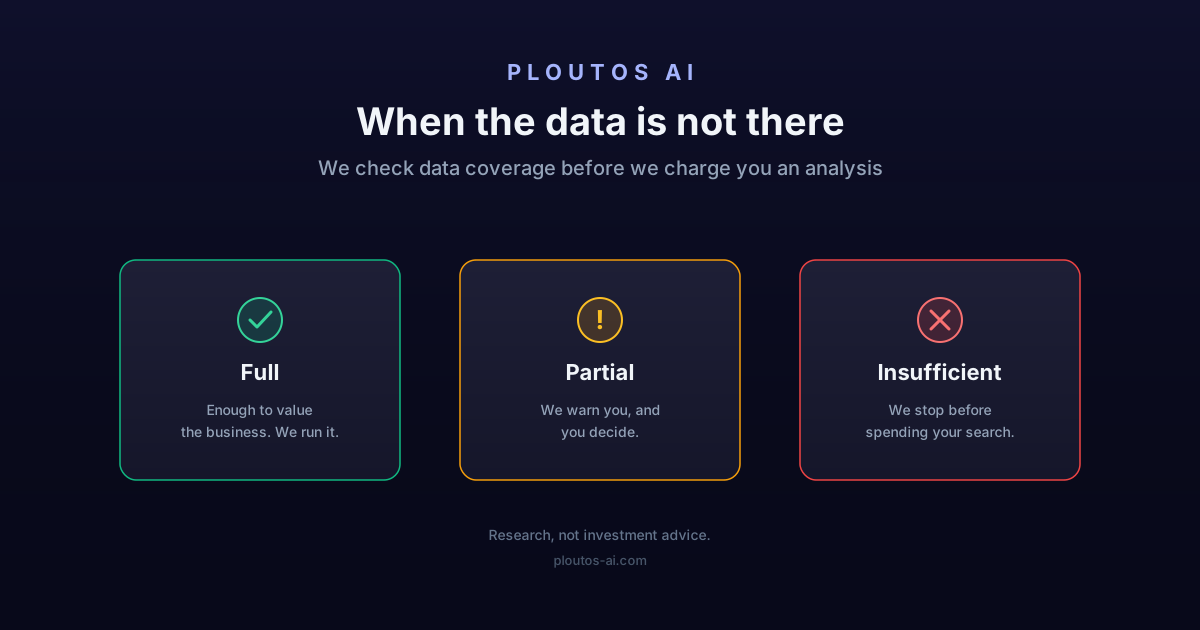
So before anything else runs, we measure how much of the data we would need is actually present. We call this data coverage, and it sorts every ticker you submit into one of three tiers.
The three tiers of data coverage
Full. We have the company's price, its share count, and most of the core fundamentals a valuation needs: earnings, margins, return on capital, cash flow, revenue, and a usable balance sheet. This is the normal case for established, well-covered companies. We proceed silently, exactly as you would expect.
Partial. The essentials are there, but several core fundamentals are missing or the company is not yet in a state where a valuation model can produce a meaningful number, for example a business that is not yet profitable and has no positive free cash flow to discount. We can still run the analysis, but the verdict will rest on less. So we tell you that, show you the trade-offs, and let you decide whether to spend an analysis on it.
Insufficient. The data is too thin to support a fundamentals verdict at all: no usable price or share count, a feed error, or only a handful of the core metrics present. This is the tier where most tools would quietly produce a number anyway. We do not. We stop and tell you what we found.
What "enough data" actually means
Coverage is not a vague feeling, it is a count. We look for two things.
First, the critical inputs: a current price and a share count. Without these, almost nothing downstream works, you cannot compute a per-share value or a margin of safety, so a verdict would be meaningless.
Second, the core fundamentals, the eight figures that actually drive a value verdict: trailing earnings, gross margin, return on invested capital, free cash flow, revenue and its growth, the balance sheet, and the price-to-earnings ratio. The more of these are missing, the less any verdict can be trusted. We also check whether at least one valuation method can run at all, which needs either positive earnings or positive free cash flow to work with.
Importantly, this is a measurement of presence, not a judgement of quality. A company can have full coverage and still score poorly, that is a real, useful answer. What coverage protects against is the opposite case: a confident answer built on absence. If you want to see what the full pipeline does once the data clears this bar, we wrote a walkthrough of how Ploutos AI analyzes a stock end to end.
Why we check this before charging you anything
The coverage check runs before an analysis is counted against your plan, and that ordering is deliberate. If a ticker is too thin to analyze honestly, we would rather spend zero of your searches on it than hand you a hollow report and quietly tick the counter down.
There is a cost on our side too, every analysis runs a multi-stage pipeline that calls a language model and a stack of data services, and burning that on a ticker we cannot do justice to is wasteful for everyone. But the user-facing reason is the one that matters: a search you spend should buy you something worth having.
What happens when a ticker is flagged
When coverage comes back partial or insufficient, you get a short, honest prompt instead of a redirect into a misleading report. It tells you what we actually have, weighs the upside of proceeding against the downside, and gives you three choices: run it anyway with your eyes open, drop the thin tickers and analyze only the ones with enough data, or step back and pick a different name. If you do proceed on partial data, the resulting analysis carries that warning forward, so the verdict is never dressed up as more certain than it is.
Why this is a feature, not a limitation
It is tempting to think that a tool which always has an answer is more powerful than one that sometimes says "not enough to go on." The opposite is true. The willingness to say I do not know is exactly what separates a research process from a guessing machine. Value investing runs on the same principle, Warren Buffett's "circle of competence" is just a disciplined way of refusing to act where you lack the information to act well.
A verdict you can trust on the companies where the data is real is worth far more than a verdict on everything, because the second kind teaches you to ignore the warning labels. When Ploutos AI does give you a full analysis, you can know that it cleared this bar first. When it declines, that is information too. You can read about what we do with a full, clean dataset in our breakdown of how the analysis pipeline works, or run an analysis and see the coverage check in action.
Frequently asked questions
Why does it sometimes refuse to analyze a stock?
When the available data is too thin for a reliable analysis, we stop rather than fill the gap with guesswork.
What counts as 'thin data'?
For example incomplete filings, a very recent IPO, or a ticker outside our coverage.
Isn't it better to always give an answer?
No. A confident answer built on missing data is worse and more dangerous than an honest 'there isn't enough information'.
Related reading
- Stock research tools that cite SEC filingsEight tools say their numbers come from SEC filings. They mean three different things. Where each one's figures actually come from, what a citation points to, and what each covers, checked on the vendors' own pages in September 2026.
- How we track our own track recordMost stock pickers quietly bury their misses. Here is how Ploutos AI records every pick at decision time and benchmarks it against the market, openly.
- Why AI stock tools hallucinateA language model will happily invent a P/E ratio or an insider trade that never happened. Here is why it happens, and how Ploutos AI prevents it.
Important notice
This article is for general educational and informational purposes only. It is not investment advice and does not take into account your personal circumstances, objectives, or financial situation. Any security named is described for illustration and is not a recommendation to buy or sell.
Investing in stocks carries risk, including the possible loss of all invested capital. The past performance of any analysis, methodology, or strategy is not a reliable indicator of future results. Different investors reach different conclusions from the same information, depending on their objectives, time horizon, and risk tolerance.
You are solely responsible for your investment decisions. Before acting on any information from this site, you should assess whether it is appropriate for your circumstances and consult an appropriately qualified professional if you are in any doubt.
See the Terms for the full disclaimer and disclosures.
Try Ploutos AI on a ticker you're researching
Free tier includes 3 deep analyses per month. No credit card required.
Get started, it's free