How to read a stock's fundamentals (without being an accountant)
Filings are huge, but you don't have to read all of it. The 3 statements, a 5-point quick scan, and 3 quality scores in plain English.
Research, not advice. This guide is educational. It explains a methodology and is not a recommendation to buy or sell any security. Full disclosure at the end.
A company's fundamentals scare most beginners. Filings are huge, full of jargon and numbers. The good news: you don't have to read all of it. You need a few things, in the right order.
The 3 statements, one sentence each
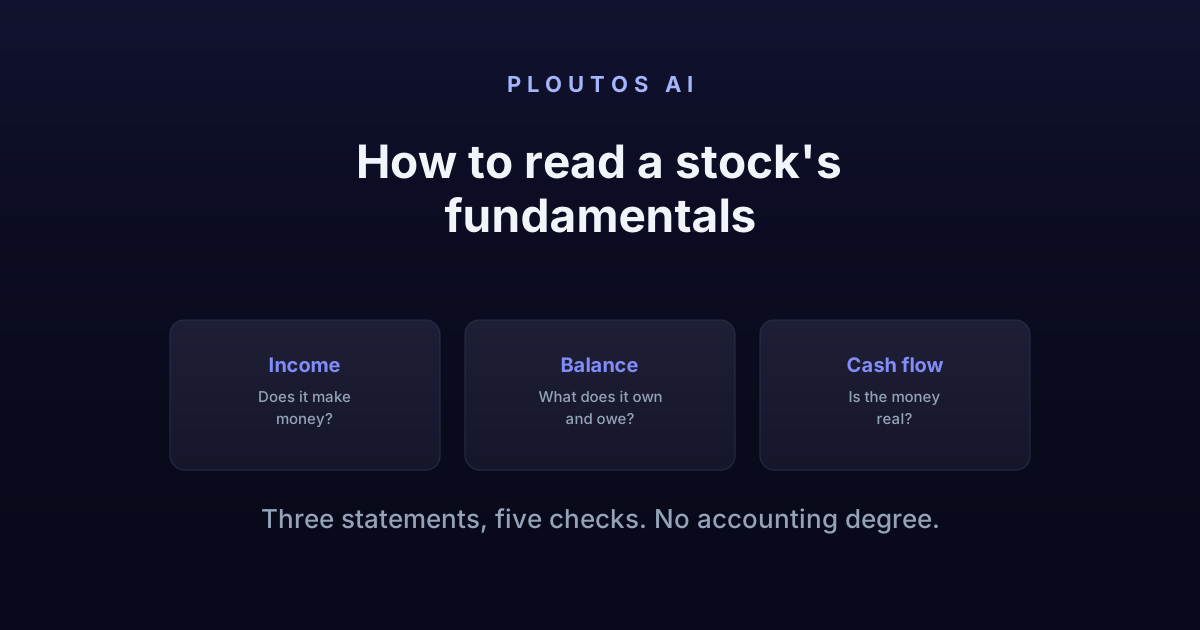
Every company publishes three core financial statements. You don't need accounting, you need to know what each one asks:
- Income statement: does the company make a profit? It shows revenue, costs, and what's left at the end.
- Balance sheet: what does it own and owe? It shows assets, debt, and equity at a point in time.
- Cash flow statement: do the earnings turn into real cash? It shows the money that actually comes in and goes out.
The third is the most underrated. A company can show profit on paper but generate no cash, and that's where a lot of problems hide.
The 5-point quick scan
Before you dig deep, this filter saves you hours. Look at five things:
- Profitability. Does it earn consistent operating profit, or live on narrative? Look at the 3-5 year trend, not one year.
- Debt. Can it survive a bad year? Compare debt to operating profit (e.g. debt-to-EBITDA). Too much debt = fragile.
- Cash flow. Is free cash flow positive and close to reported earnings? If earnings are far bigger than cash, find out why.
- Valuation. Are you paying reasonably or pricing in a perfect future? This is where fair value and margin of safety help.
- Quality of the numbers. Are there signs something is being inflated? (More below.)
If any of these flags a problem, you stop there. You don't need to read 200 pages on a company with collapsing margins.
Three quality scores that summarise a lot
Instead of weighing dozens of figures, three classic scores give a quick read:
- Piotroski F-Score (0-9): uses 9 simple checks to show whether fundamentals are improving or deteriorating. An 8-9 is a strong quality signal.
- Altman Z-Score: estimates bankruptcy risk. It tells you whether the balance sheet is in a safe or dangerous zone.
- Beneish M-Score: surfaces the likelihood of earnings 'cooking'. Not proof of fraud, but a signal to look more closely.
They're not magic, but a clearly bad score on these saves a lot of wasted time.
The most insidious red flag
The most dangerous sign in a company isn't one big hole that shouts. It's when no red flag shows, because the 'cooking' has been spread a little everywhere: in how they capitalise R&D, in depreciation, in stock compensation, in adjusted or non-GAAP earnings that conveniently make the ugly parts disappear.
A practical rule: always go back to the GAAP numbers (the official ones), not the adjusted ones the company serves you. Non-GAAP gives a 'clean' story, and then you have to roll it back to GAAP to see what was removed or added.
Where tools take it from here
The mechanical part, gathering and checking all of this, is time-consuming but automatable. With one condition: the numbers have to be real. A general-purpose language model often invents figures with confidence, so a tool is only worth it if its data comes from the official filings, not from its "memory".
If you want to see these checks run automatically in one structured analysis, with the sources in front, you can run one on a stock you know well.
What this means for you
You don't need to become an accountant. You need to know what each statement asks, run the 5-point quick scan, and not blindly trust adjusted numbers. With that, in a few minutes you can separate what's worth digging into from what to leave.
Frequently asked questions
What are a stock's fundamentals?
They are the financials of the business behind the stock: revenue, earnings, debt, cash flow, margins. Fundamental analysis looks at the health and value of the company, as opposed to technical analysis, which looks at the price and the chart.
What are the 3 core financial statements?
The income statement (does the company make a profit?), the balance sheet (what does it own and owe?), and the cash flow statement (do the earnings turn into real cash?). Together they give the full picture.
Do I have to read the whole 10-K?
No. A 10-K is hundreds of pages, but for a first read a few figures are enough: profitability, debt, cash flow, valuation, and the quality of the numbers. If any of those flags a problem, you stop there.
What is the Piotroski score?
A 0-9 score that uses 9 simple checks to show whether a company's fundamentals are improving or deteriorating (profitability, leverage, efficiency). An 8-9 is a quality signal, a 2-3 a warning.
What is the most insidious red flag?
When it looks like there is none. Spread-thin 'cooking', a little in R&D capitalisation, a little in depreciation, a little in adjusted/non-GAAP earnings, is hard to filter because no single figure screams.
Related reading
- How to read a 10-KWhat a 10-K is, where to find it, which parts to read first and what to look for in each. A guide to the annual filing US companies make with the SEC.
- Insider trades and Form 4: what they meanWhat Form 4 is, who counts as an insider, how to tell a real purchase from stock pay, and why an executive's sale usually says less than a purchase.
- ROIC and ROE: what they show and how they differReturn on invested capital (ROIC) and return on equity (ROE) explained simply: how they are calculated, why ROE is flattered by debt, and why ROIC says more about the quality of a business.
Important notice
This article is for general educational and informational purposes only. It is not investment advice and does not take into account your personal circumstances, objectives, or financial situation. Any security named is described for illustration and is not a recommendation to buy or sell.
Investing in stocks carries risk, including the possible loss of all invested capital. The past performance of any analysis, methodology, or strategy is not a reliable indicator of future results. Different investors reach different conclusions from the same information, depending on their objectives, time horizon, and risk tolerance.
You are solely responsible for your investment decisions. Before acting on any information from this site, you should assess whether it is appropriate for your circumstances and consult an appropriately qualified professional if you are in any doubt.
See the Terms for the full disclaimer and disclosures.
Try Ploutos AI on a ticker you're researching
Free tier includes 3 deep analyses per month. No credit card required.
Get started, it's free