What does 'undervalued' really mean: margin of safety and value traps
A low price doesn't mean undervalued. See what intrinsic value is, what margin of safety means, and how to tell a real opportunity from a value trap.
Research, not advice. This guide is educational. It explains a methodology and is not a recommendation to buy or sell any security. Full disclosure at the end.
One of the most misunderstood words in investing is "undervalued". Most people confuse it with "cheap", meaning a low number on the ticker. They are not the same, and the difference is the whole game.
Price vs value
Price is what you pay. Value is what you get. A stock is undervalued when its price is below the intrinsic value of the business, regardless of whether the price number is large or small.
A stock at 500 can be undervalued if the company is worth 800. A stock at 2 can be expensive if the company is worth 1. "Cheap as a number" tells you nothing on its own.
How you approach "value"
Intrinsic value is not visible on the ticker, you estimate it. The most common way is a DCF (Discounted Cash Flow): you work out how much cash the company will generate in the future and discount it back to today. A DCF is not a crystal ball, it's a model, and it's only as good as its assumptions. For how it works and why analyst price targets so often miss, see the guide to DCF valuation.
Because every value estimate carries uncertainty, it isn't enough to buy "at value". You need a buffer.
Margin of safety: the most important part
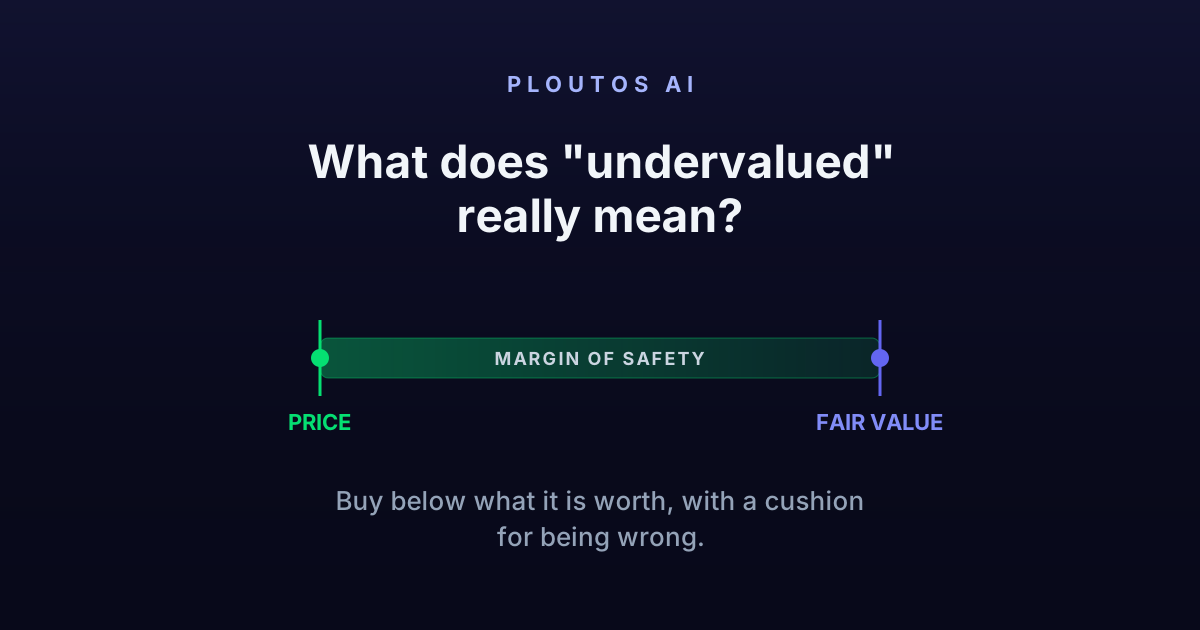
The margin of safety is the idea that made Benjamin Graham and Warren Buffett famous: buy far enough below your estimate of value that, even if your estimate is wrong, you aren't ruined.
If you estimate a company is worth 100 per share and you buy at 70, you have a 30% margin. That protects you from two things:
- Being wrong on the estimate. Maybe the company is actually worth 85, not 100. Buying at 70, you still come out ahead.
- Bad luck. An unexpected bad year, a sector shock. The margin absorbs part of the hit.
The more uncertain the company (cyclical, no strong economic moat), the bigger the margin you want.
The trap: value traps
This is where most people lose. A stock that looks cheap (low P/E, beaten-down price) is not automatically an opportunity. It can be a value trap: cheap for a reason.
Signs you are looking at a value trap, not an opportunity:
- A declining business. Revenue or margins shrinking year after year.
- Losing share to a faster competitor or a new technology.
- Burning cash or carrying debt that is strangling it.
- The "cheap" never closes. The price keeps falling and the low P/E just trails the falling earnings.
The difference between an opportunity and a trap is not in the price. It's in the business: is it temporarily misunderstood, or permanently broken?
The special case: companies with no earnings
When a company has no earnings yet (many tech, early-stage), P/E doesn't help, there isn't one. There, valuation becomes purely forward-looking: you have to estimate when and how much it will become profitable, based on the business. It's the hardest case, and where most people either dramatically over- or under-estimate.
What this means for you
"Undervalued" does not mean "cheap". It means: you estimate the value of the business, you buy far enough below it, and you make sure the discount is due to the market misunderstanding something, not a real problem. The two tools are the margin of safety (buying discipline) and understanding the business (so you don't fall into a value trap).
If you want to see fair value computed with DCF, margin of safety, and a read of the business in one structured analysis, you can run one on a stock you know well.
Frequently asked questions
What does 'undervalued' mean?
An undervalued stock is one whose market price is below the intrinsic (real) value of the business. It has nothing to do with whether the price is a small number. A stock at 500 can be undervalued and one at 3 can be expensive.
What is margin of safety?
It is the safety buffer: you buy far enough below your estimate of value that, even if your estimate is somewhat wrong, you don't lose. If you estimate value at 100 and buy at 70, you have a 30% margin of safety.
How do I work out a stock's real value?
The most common method is a DCF: you discount the company's future cash flows back to today. It's an estimate, not an exact number, and it depends on your assumptions, which is exactly why you also need a margin of safety.
What is a value trap?
A stock that looks cheap (low P/E, low price) but is cheap for a reason: the business is declining, losing share, or burning cash. The price keeps falling and the 'discount' never closes.
Does a low P/E mean a stock is undervalued?
Not necessarily. A low P/E can mean the market expects earnings to fall (value trap), or that the sector is cyclical. P/E is a hint, not proof of undervaluation.
Related reading
- How to read a 10-KWhat a 10-K is, where to find it, which parts to read first and what to look for in each. A guide to the annual filing US companies make with the SEC.
- Insider trades and Form 4: what they meanWhat Form 4 is, who counts as an insider, how to tell a real purchase from stock pay, and why an executive's sale usually says less than a purchase.
- ROIC and ROE: what they show and how they differReturn on invested capital (ROIC) and return on equity (ROE) explained simply: how they are calculated, why ROE is flattered by debt, and why ROIC says more about the quality of a business.
Important notice
This article is for general educational and informational purposes only. It is not investment advice and does not take into account your personal circumstances, objectives, or financial situation. Any security named is described for illustration and is not a recommendation to buy or sell.
Investing in stocks carries risk, including the possible loss of all invested capital. The past performance of any analysis, methodology, or strategy is not a reliable indicator of future results. Different investors reach different conclusions from the same information, depending on their objectives, time horizon, and risk tolerance.
You are solely responsible for your investment decisions. Before acting on any information from this site, you should assess whether it is appropriate for your circumstances and consult an appropriately qualified professional if you are in any doubt.
See the Terms for the full disclaimer and disclosures.
Try Ploutos AI on a ticker you're researching
Free tier includes 3 deep analyses per month. No credit card required.
Get started, it's free