Why AI stock tools hallucinate, and how we stop it
A language model will happily invent a P/E ratio or an insider trade that never happened. Here is why it happens, and how Ploutos AI prevents it.
Research, not advice. This guide is educational. It explains a methodology and is not a recommendation to buy or sell any security. Full disclosure at the end.
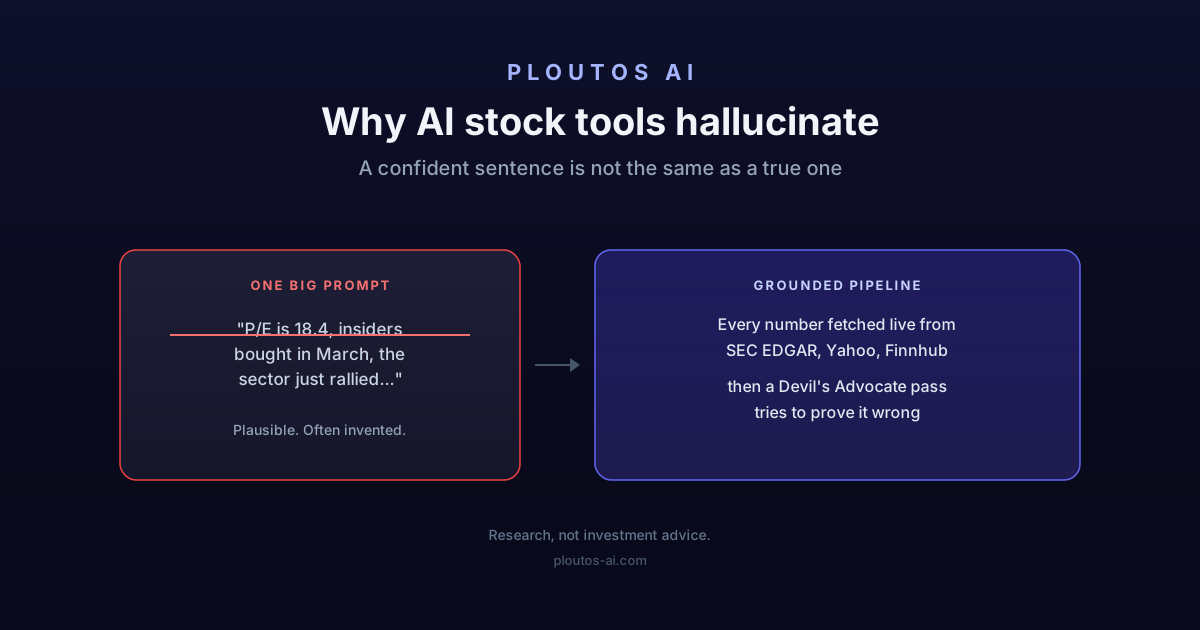
Paste a ticker into a general-purpose chatbot and ask for an analysis, and you will get something that reads beautifully: a tidy P/E ratio, a confident note about insiders buying last quarter, a clean paragraph on how the sector is rotating. The prose is fluent, the structure is professional, the tone is certain.
A lot of it may also be false. Not because the model is broken, but because it is doing exactly what it was built to do, and that job is not "report facts."
What a hallucination looks like in stock analysis
In AI, a "hallucination" is a confident, fluent, plausible statement that simply is not true. In finance the failure is especially dangerous, because the output is full of exactly the specifics that make it look trustworthy:
- A valuation multiple that is close to reality but quietly wrong, last year's P/E, or a forward figure presented as trailing.
- An insider transaction that never happened, or a real one with the direction flipped.
- A catalyst lifted from an article that is two years old, described as if it were this week.
- A cited source that does not exist, a report, a filing, an analyst note, fabricated wholesale because the sentence needed a citation to sound complete.
The unifying problem is that none of these are flagged as guesses. They sit in the same confident paragraph as the genuinely correct statements, and nothing in the text tells you which is which.
Why it happens: the model predicts words, not facts
A large language model is, at its core, a very sophisticated next-word predictor. It has read an enormous amount of text and learned what tends to come next. When you ask it for a company's free cash flow, it does not look up the number. It generates the most statistically plausible continuation of your question, and a specific-looking number is more plausible than "I am not sure."
That is the whole trap. The model is optimised to be fluent, and fluency rewards confident specifics. "Its return on capital is around 14%" reads better than "I would need to check." So when the real figure is not reliably encoded in its training, the model does not stop, it produces a number that fits the shape of an answer. For casual writing that is fine. For an investment decision it is a landmine.
Two structural weaknesses make it worse:
- Training data is frozen and fuzzy. A model trained months ago has no idea what a company reported last week, and even older figures are blended across everything it ever read, not stored as a clean ledger.
- The model wants to agree with itself. Once it has written "the bull case is strong" in the opening, the rest of the answer tends to confirm that, not challenge it. This is confirmation bias, baked in.
The fix, part one: do not ask the model to remember, make it fetch
The single most important design decision in Ploutos AI is that the language model is never the source of a number. Every figure that enters an analysis is fetched live, at the moment you run it, from a real source: fundamentals and prices, filings from SEC EDGAR for insider transactions and material events, news and sentiment feeds, and so on.
The model's job is reframed from "recall the facts" to "reason over facts I am handing you right now." That is a job language models are genuinely good at, weighing a return-on-capital figure against a sector average, noticing that free cash flow diverges from reported earnings, connecting an 8-K filing to a stated risk. The numbers are not its opinion, they are inputs it is not allowed to invent. And when the data simply is not there, we stop rather than fill the gap with a guess.
This is also why the work is split into stages rather than one giant prompt. Each stage has a narrow job grounded in specific data, which leaves far less room for the model to drift into invention. The full sequence is described in our walkthrough of the analysis pipeline.
The fix, part two: make the model argue against itself
Grounding kills invented facts. It does not, on its own, kill the second problem, the model talking itself into its own conclusion. For that we add a deliberately adversarial step.
After a verdict is formed, a separate and more capable model pass receives the picks with a single instruction: find what we got wrong. It is told to behave like a hostile short-seller. For each idea it has to produce the weakest assumption in the thesis, a risk the first pass did not flag, a concrete bear case, and the specific observable event that would prove the thesis wrong.
This matters most exactly where confirmation bias is most dangerous: on the ideas that scored well. A tool that only ever tells you why an idea is good is not doing research, it is doing marketing. Forcing a structured rebuttal is the antidote.
Why "just cite your sources" is not enough
A common half-measure is to ask the model to cite sources. It helps with appearances and almost nothing else, because a model that will invent a P/E will just as happily invent the citation next to it. A fabricated footnote is not a safeguard, it is a second hallucination wearing a suit.
The only reliable fix is architectural: the facts must come from outside the model and be verifiable, and the reasoning must be stress-tested by something whose job is to disagree. Citations are a presentation layer. Grounding is a plumbing layer. They are not substitutes.
What this means for you
When you read an AI stock analysis, the right question is not "does this sound smart?" Fluency is free, and it is exactly what a hallucination is made of. The right questions are: where did each number come from, and what tried to prove this wrong?
That is the bar we hold ourselves to. Numbers are fetched, not remembered. Conclusions are challenged, not just stated. And when the data is too thin to do either honestly, we say so. If you want to see the grounded pipeline produce a full analysis, you can run one, or read how the five stages fit together.
Frequently asked questions
Why do AI stock tools invent figures?
A language model predicts the most likely next word, not the fact. When it doesn't reliably 'remember' a number, it produces one that looks right instead of saying 'I don't know'.
How is it prevented?
Numbers are fetched live from the official filings (grounding), not from the model's memory, and a separate pass challenges the conclusion.
Isn't it enough to 'cite sources'?
No. A model that will invent a P/E will just as happily invent the citation next to it. Grounding has to be architectural, not cosmetic.
How do I know if an AI analysis is trustworthy?
Ask: where did each number come from, and what tried to prove it wrong? If the numbers have no verifiable source, treat them with caution.
Related reading
- Stock research tools that cite SEC filingsEight tools say their numbers come from SEC filings. They mean three different things. Where each one's figures actually come from, what a citation points to, and what each covers, checked on the vendors' own pages in September 2026.
- How we track our own track recordMost stock pickers quietly bury their misses. Here is how Ploutos AI records every pick at decision time and benchmarks it against the market, openly.
- Why we refuse to analyze a stockIncomplete data produces a confident but misleading verdict. Here is how Ploutos AI checks data coverage before spending your analysis, and when it stops.
Important notice
This article is for general educational and informational purposes only. It is not investment advice and does not take into account your personal circumstances, objectives, or financial situation. Any security named is described for illustration and is not a recommendation to buy or sell.
Investing in stocks carries risk, including the possible loss of all invested capital. The past performance of any analysis, methodology, or strategy is not a reliable indicator of future results. Different investors reach different conclusions from the same information, depending on their objectives, time horizon, and risk tolerance.
You are solely responsible for your investment decisions. Before acting on any information from this site, you should assess whether it is appropriate for your circumstances and consult an appropriately qualified professional if you are in any doubt.
See the Terms for the full disclaimer and disclosures.
Try Ploutos AI on a ticker you're researching
Free tier includes 3 deep analyses per month. No credit card required.
Get started, it's free