How we track our own track record (and why most pickers hide theirs)
Most stock pickers quietly bury their misses. Here is how Ploutos AI records every pick at decision time and benchmarks it against the market, openly.
Research, not advice. This guide is educational. It explains a methodology and is not a recommendation to buy or sell any security. Full disclosure at the end.
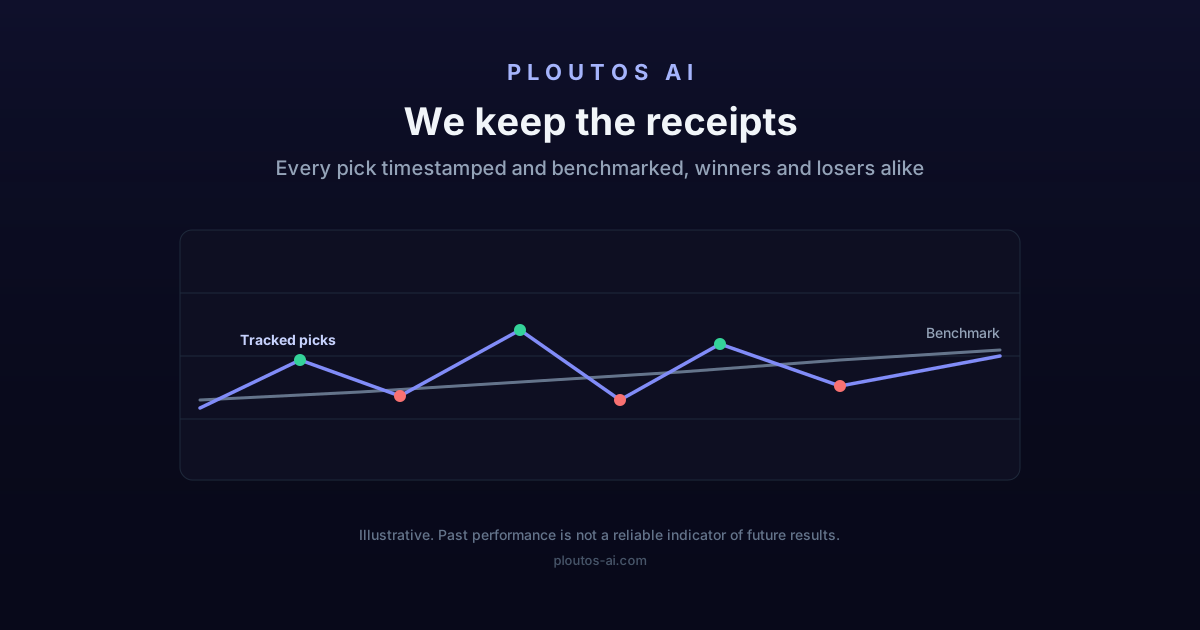
Watch finance content for a week and you will see a hundred confident calls and almost no scorecards. Every screenshot is a winner. Every "I told you so" arrives after the fact. The losing calls quietly evaporate, and the ones that worked get pinned to the top of the feed.
This is not usually fraud. It is something more ordinary and more corrosive: a thousand small choices about what to show and what to forget, all leaning in the same flattering direction. A research tool that wants to be trusted has to do the opposite, and it has to do it by design, not by good intentions.
Survivorship bias: why most track records are fiction
The technical name for the trick is survivorship bias: you judge a strategy only by the examples that survived, because the failures are no longer in front of you. A pundit who makes fifty predictions and reminds you of the five that landed looks like a genius. The other forty-five are not lies, they are just gone.
It has a close cousin, hindsight bias: the temptation to describe a call as cleaner and more confident than it actually was at the time. "I always said that sector would rebound" is easy to write once it has rebounded.
Both biases share one root cause: there is no fixed, timestamped record of what was actually claimed, and when. Remove that record and any track record becomes a story you tell about the past. Keep it, rigorously, and the story has to match the receipts.
We timestamp every pick at decision time
The foundation is simple and unglamorous: the moment an analysis produces a verdict, that verdict is recorded, with its date, its rating, and the price at that instant. It is frozen. Nothing about it can be quietly edited later to look smarter.
That timestamp is what makes the whole thing honest. Performance is always measured from the price on the day the call was made, not from some flattering entry point chosen afterwards. There is no reaching back to start the clock at a convenient low. The clock starts when the analysis ran, and you can see the analysis that produced it, the same structured output and Devil's Advocate critique you saw on the day.
Benchmark against the market, not against zero
"Up 12%" sounds great until you learn the whole market was up 15% over the same window. A number on its own is not a result, the only honest scorecard is relative to the alternative you actually had.
So every tracked pick is measured against a broad market benchmark over the same period. The question is never just "did this go up," it is "did this do better or worse than simply owning the index instead." That is a far harder bar to clear, and it is the only one that tells you whether the research added anything at all. Beating zero is luck in a bull market. Beating the market is the thing that has to be earned.
We show the losers too
A scorecard that only contains winners is not a scorecard. The track record surfaces the full distribution, the best calls and the worst ones side by side, not a curated highlight reel. If a thesis underperformed, it stays on the record underperforming.
This is uncomfortable on purpose. A tool that hides its misses is optimising for how it looks, and the moment it does that it stops being useful to you. Seeing where the process was wrong is exactly how you calibrate how much weight to give it, and it is information a marketing page will never volunteer. The same discipline runs through the product itself: every submitted ticker gets an honest verdict even when that verdict is negative, and the analysis stops rather than guess when the data is too thin.
Why past performance still is not a promise
Here is the part that honesty requires us to say plainly, even though it undercuts the marketing: a good track record is not a guarantee of future results, and you should distrust anyone who implies otherwise.
Markets change regimes. A process that suited the last few years can struggle in the next. Sample sizes are smaller than they look, and luck and skill are genuinely hard to separate over short windows. A transparent track record is valuable not because it predicts the future, but because it tells you the truth about the past, which biases, sample size, benchmark, and all. That is the most any honest scorecard can offer, and it is a great deal more than most offer at all.
See it for yourself
The point of tracking openly is that you do not have to take any of this on faith. You can look at the public track record and your own performance history, timestamps, benchmark comparison, winners and losers included. Then read how the underlying analysis is produced in our walkthrough of the pipeline, and decide for yourself how much weight the process has earned.
Frequently asked questions
How is the track record measured?
Each pick is tracked from its entry price, marked to market, and compared against the index (SPY) over the same period.
What is alpha?
How a pick did relative to the market (S&P 500). Positive alpha means it beat the index.
Why make it public?
Because the right way to earn trust isn't 'trust me', it's showing what actually happened, the good moves and the bad.
Do a few weeks of track record mean anything?
No. A forward track record needs months to mean something. A few weeks is an indication, not proof.
Related reading
- Stock research tools that cite SEC filingsEight tools say their numbers come from SEC filings. They mean three different things. Where each one's figures actually come from, what a citation points to, and what each covers, checked on the vendors' own pages in September 2026.
- Why AI stock tools hallucinateA language model will happily invent a P/E ratio or an insider trade that never happened. Here is why it happens, and how Ploutos AI prevents it.
- Why we refuse to analyze a stockIncomplete data produces a confident but misleading verdict. Here is how Ploutos AI checks data coverage before spending your analysis, and when it stops.
Important notice
This article is for general educational and informational purposes only. It is not investment advice and does not take into account your personal circumstances, objectives, or financial situation. Any security named is described for illustration and is not a recommendation to buy or sell.
Investing in stocks carries risk, including the possible loss of all invested capital. The past performance of any analysis, methodology, or strategy is not a reliable indicator of future results. Different investors reach different conclusions from the same information, depending on their objectives, time horizon, and risk tolerance.
You are solely responsible for your investment decisions. Before acting on any information from this site, you should assess whether it is appropriate for your circumstances and consult an appropriately qualified professional if you are in any doubt.
See the Terms for the full disclaimer and disclosures.
Try Ploutos AI on a ticker you're researching
Free tier includes 3 deep analyses per month. No credit card required.
Get started, it's free