What is an economic moat, and how do you actually measure it?
An economic moat is a durable competitive advantage. Here is what one looks like, the main types, and how to measure it from a company's financial fingerprint.
Research, not advice. This guide is educational. It explains a methodology and is not a recommendation to buy or sell any security. Full disclosure at the end.
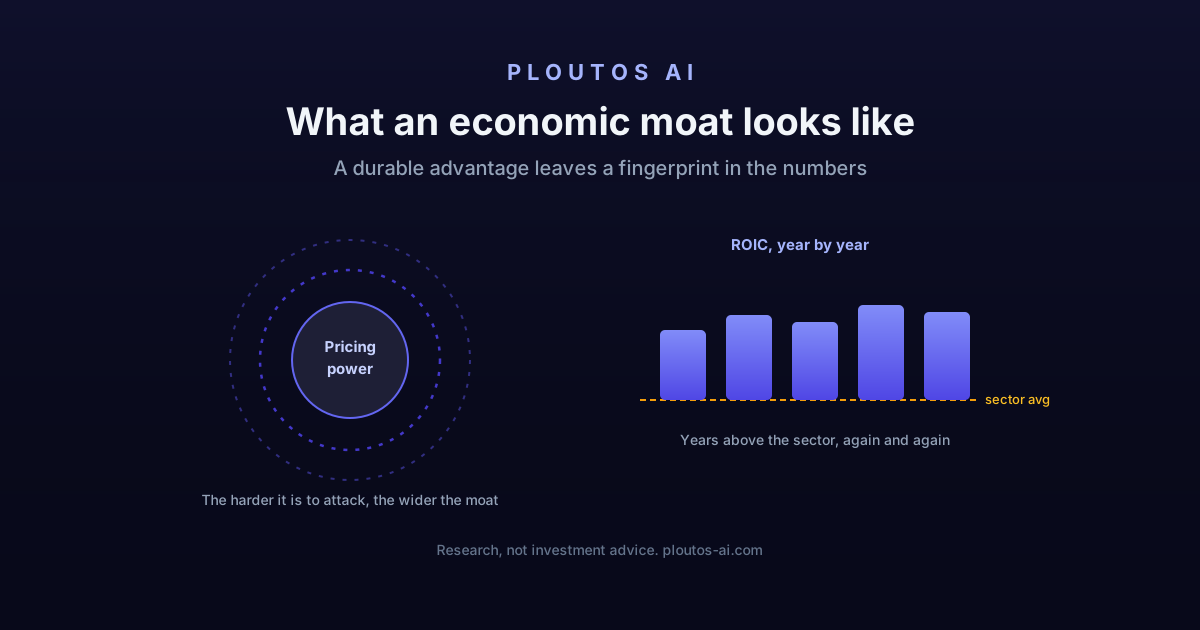
Warren Buffett popularised one of the most useful images in investing. Picture a great business as a castle, and its profits as the treasure inside. Every profitable castle attracts attackers, competitors who want a share of that treasure. What protects it over time is the moat: a structural advantage that makes the castle genuinely hard to attack.
A company without a moat can earn high returns for a while, but competition eventually arrives, undercuts its prices, and grinds those returns back down to ordinary. A company with a moat can defend its profits for years, sometimes decades. For a long-term investor, almost nothing matters more, and almost nothing is harder to measure honestly.
What an economic moat actually is
An economic moat is a durable competitive advantage, the operative word being durable. It is the reason a business can keep earning returns on its capital that are well above the cost of that capital, without competition immediately competing those returns away.
That phrase, returns above the cost of capital, is the whole game. Any company can grow by pouring in more money. The question that separates a great business from a merely large one is whether each dollar it invests comes back as meaningfully more than a dollar, year after year, even when rivals are trying to take its lunch. A moat is the structural reason the answer stays yes.
The main types of moat
Moats come in a handful of recognisable shapes:
- Network effects. The product gets more valuable as more people use it. A marketplace or a payments network is worth more to each user precisely because everyone else is already there, which makes it extremely hard for a newcomer to break in.
- Switching costs. Once a customer is embedded, leaving is painful, expensive, or risky. Enterprise software that a whole company runs on is a classic example, the cost is not the subscription, it is the migration.
- Cost advantage. The business can produce the same thing more cheaply than anyone else, through scale, location, or a unique process, and can therefore undercut rivals and still profit.
- Intangible assets. Brands that let a company charge a premium, patents that lock out imitation, or regulatory licences that competitors cannot easily obtain.
- Efficient scale. A market just big enough for one or two players to serve profitably, where a third entrant would make the economics bad for everyone, so none arrive.
The names matter less than the test they all have to pass: does this advantage persist when a well-funded competitor attacks it? A trendy product is not a moat. A patent that expires next year is a shrinking one.
The measurement problem
Here is the hard part. The descriptions above are qualitative, you can only really confirm a network effect or a switching cost by understanding the business deeply, reading its filings, and watching how it behaves over years. You cannot do that, by hand, across thousands of companies. So how does an automated process judge something this subtle?
The answer is to stop trying to read the moat directly and instead look for the fingerprint it leaves in the financial statements. A real, durable advantage is not just a story, it shows up in the numbers, because a business that can defend its profits actually keeps earning them. That is something you can measure.
The financial fingerprint of a moat
Two signals do most of the work.
High and persistent return on invested capital (ROIC). A single great year of ROIC proves nothing, anyone can get lucky once. What a moat produces is ROIC that stays well above the sector average year after year after year. The persistence is the signal. A business that earns far more on its capital than its peers, and keeps doing so across an entire cycle, is almost certainly being protected by something structural, even if you cannot name it from the outside. So we look not just at the level of ROIC but at how many of the recent years cleared the sector bar.
Premium gross margins. Pricing power, the ability to charge more than rivals without losing customers, is the most visible symptom of a moat. It shows up as a gross margin meaningfully above the sector. A company with no advantage has to compete on price, which compresses margins toward the industry average. A company that holds a premium margin for years is telling you customers are paying up for something they cannot easily get elsewhere.
Combine the two and you get a defensible, repeatable classification, which is exactly how Ploutos AI grades it.
Wide, narrow, or none
The classification lands in three buckets:
- Wide moat. ROIC has been far above the sector, with consistency across most of the observed years, and gross margins carry a clear premium. This is the rare, durable-advantage profile.
- Narrow moat. A real but more modest edge, returns above the sector with decent consistency, or clear pricing power with respectable returns. An advantage, but one a determined competitor could erode.
- None. The financial fingerprint of commodity-like economics: returns near or below the cost of capital, no margin premium. The business may still be a fine investment at the right price, but you should not pay up expecting a durable advantage that the numbers do not support.
No single year and no single metric earns a "wide" label. It takes a pattern that holds up over time, which is the point, a moat that only existed last quarter was never a moat.
Why a moat changes how much margin of safety you need
This is where the concept becomes practical. A moat does not just describe a business, it should change the price you are willing to pay for it.
A wide-moat company can reinvest its profits at high returns for years, which means its intrinsic value tends to grow over time. That durability justifies accepting a smaller discount to fair value, a smaller margin of safety, because time is working for you. A no-moat business is the opposite: its advantage, if any, is fragile, its returns are more likely to fade, so you should demand a larger discount to compensate for that fragility before the price looks attractive.
In other words, quality and price are not separate questions, they are the same question. A moat is one of the cleanest ways to ask it rigorously. If you want to see a moat classification produced alongside a full valuation and the rest of the research, you can run an analysis, or read how moat, valuation, and the other signals come together in the full pipeline.
Frequently asked questions
What is an economic moat?
The durable competitive advantage that protects a company's profits from competitors, like a moat around a castle.
What types of moat are there?
The main ones: network effects, switching costs, intangibles (brand, patents), cost advantage, and efficient scale.
How do you measure a moat in practice?
From durable high margins and ROIC over time, and from how hard it is for someone to copy the business.
Why does a moat matter to an investor?
A wide moat means more predictable and durable profits, which support a valuation over the long run.
Related reading
- How to read a 10-KWhat a 10-K is, where to find it, which parts to read first and what to look for in each. A guide to the annual filing US companies make with the SEC.
- Insider trades and Form 4: what they meanWhat Form 4 is, who counts as an insider, how to tell a real purchase from stock pay, and why an executive's sale usually says less than a purchase.
- ROIC and ROE: what they show and how they differReturn on invested capital (ROIC) and return on equity (ROE) explained simply: how they are calculated, why ROE is flattered by debt, and why ROIC says more about the quality of a business.
Important notice
This article is for general educational and informational purposes only. It is not investment advice and does not take into account your personal circumstances, objectives, or financial situation. Any security named is described for illustration and is not a recommendation to buy or sell.
Investing in stocks carries risk, including the possible loss of all invested capital. The past performance of any analysis, methodology, or strategy is not a reliable indicator of future results. Different investors reach different conclusions from the same information, depending on their objectives, time horizon, and risk tolerance.
You are solely responsible for your investment decisions. Before acting on any information from this site, you should assess whether it is appropriate for your circumstances and consult an appropriately qualified professional if you are in any doubt.
See the Terms for the full disclaimer and disclosures.
Try Ploutos AI on a ticker you're researching
Free tier includes 3 deep analyses per month. No credit card required.
Get started, it's free