What is DCF valuation, and why analyst price targets are often wrong
Discounted cash flow, explained simply: valuing a company by its future cash, why a single DCF is fragile, and why analyst price targets are often unreliable.
Research, not advice. This guide is educational. It explains a methodology and is not a recommendation to buy or sell any security. Full disclosure at the end.
The price of a stock is what the market is asking for it today. The value of a stock is a separate question: what is the underlying business actually worth? Those two numbers are often very different, and the entire discipline of value investing lives in the gap between them.
Discounted cash flow, or DCF, is the most fundamental tool for answering the second question. It is also one of the most misused. This article explains what a DCF really does, why a single DCF can be dangerously fragile, and why a careful process leans on it without trusting it alone.
The one idea behind DCF: time has a price
Imagine someone offers you 1,000 euros. Would you rather have it today or in five years? Today, obviously, and not only because of impatience. Money today can be invested, it carries no risk of never arriving, and inflation erodes the value of money you receive later. So a euro in the future is worth less than a euro now, and the further away it is, the less it is worth.
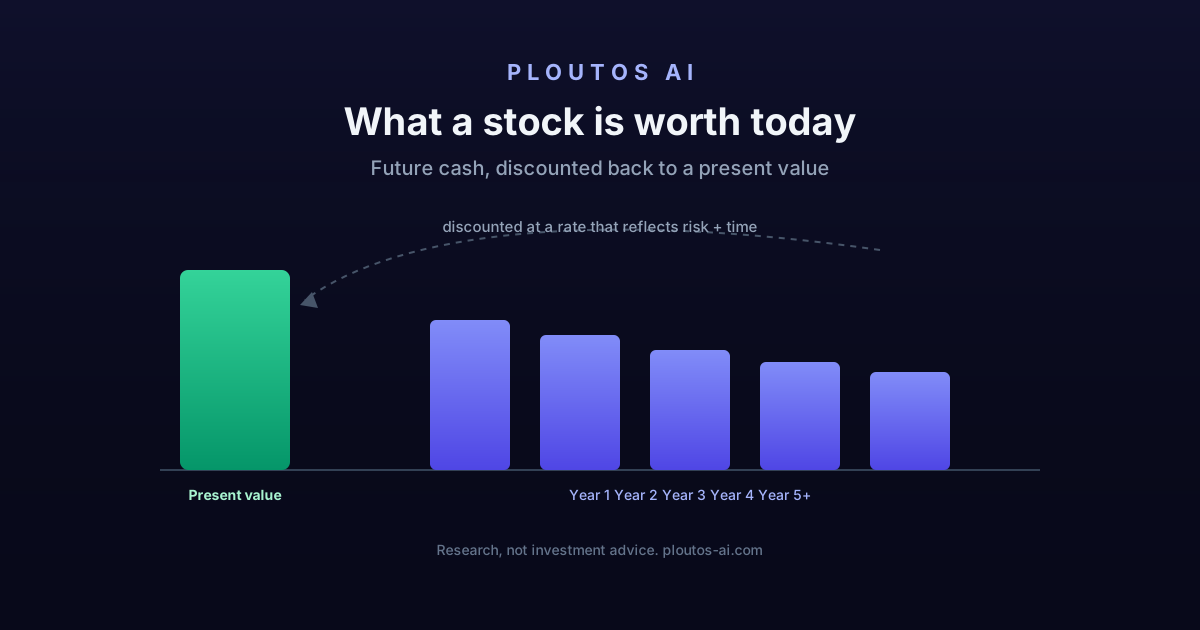
DCF takes that intuition and turns it into arithmetic. A business is, in the end, a machine for producing cash over time. If you can estimate the cash it will generate in the years ahead, and you can put a price on waiting, then you can translate all that future cash into a single number: what it is worth today. That number is the company's intrinsic value, and dividing it by the share count gives you a value per share to compare against the market price.
How a DCF actually works, in three steps
Step 1: Project the cash flows. Start from the company's free cash flow, the cash left over after it pays to run and maintain the business, and project it forward, usually about ten years, using a growth rate. A mature, stable business might be assumed to grow that cash flow at a low single-digit rate, a faster-growing company at something higher, typically tapering toward a modest long-term rate as it matures.
Step 2: Discount each year back to today. This is the "discounted" part. Each future year's cash flow is divided by a discount rate that reflects risk and the time value of money. A common shorthand: at a 10% discount rate, 1,000 euros a year from now is worth about 909 euros today, and 1,000 euros ten years out is worth only about 386. Riskier businesses get a higher discount rate, which shrinks their future cash more aggressively.
Step 3: Add a terminal value. A company does not stop existing in year ten. To capture everything after the explicit forecast, you add a terminal value, an estimate of all the cash beyond the projection, assuming a slow, steady long-term growth rate. This is then discounted back like everything else.
Add up all the discounted yearly cash flows and the discounted terminal value, and you have the estimated intrinsic value of the whole business today.
Why a single DCF is dangerously fragile
Here is the catch that humbles everyone who builds one: a DCF is exquisitely sensitive to its inputs. Nudge the growth rate up by two points and lower the discount rate by one, and the "fair value" can swing 40% or more. The model produces a precise-looking number, but that precision is an illusion, it inherits all the uncertainty of the assumptions you fed it. Garbage in, confidently-formatted garbage out.
This is why a DCF in the wrong hands becomes a way to justify a conclusion you already had. Want the stock to look cheap? Bump the growth rate. Want it to look expensive? Raise the discount rate. The math is honest, but it will faithfully launder a biased assumption into an authoritative-looking target.
Why we use a sector-aware ensemble, not one model
The defence against that fragility is not a better single model, it is refusing to rely on any single model, and refusing to force every company through the same handful of numbers regardless of what kind of business it actually is. Ploutos AI estimates fair value with an ensemble of methods that adapts to the company, each with different blind spots:
- DCF, the growth-aware estimate described above, for businesses with real free cash flow to project.
- Growth DCF, for young, fast-growing companies that aren't profitable yet: it projects revenue instead of cash flow and models the profit margin maturing gradually over a longer horizon, instead of refusing to value the company at all.
- Sector multiples, what comparable companies trade at on earnings, sales, and operating profit, adjusted for quality.
- Earnings Power Value (EPV), a conservative anchor that assumes zero growth and asks what the business is worth purely on its current earning power. If a DCF says a company is cheap but EPV strongly disagrees, that tension is itself a signal.
- The Graham Number, a classic book-value-and-earnings benchmark from Benjamin Graham.
- Sector specialists, for the businesses a generic ensemble handles badly: an H-model dividend discount for regulated utilities with a stable, policy-driven payout, a net-asset-value calculation for companies whose balance sheet is dominated by digital-asset holdings, and a conservative net-cash floor for pre-revenue biotech, where a full valuation isn't possible without clinical-trial data.
These are blended with weights that depend on the sector and the company's own financial profile, because book value matters more for a bank than for a software company, and a pre-profit growth story needs a different lens than a mature dividend payer, and the result comes with a confidence level and a fair-value range, not a single false-precision point. When the applicable methods agree, confidence is high. When they scatter widely, that disagreement is reported rather than hidden. Quality also bends the inputs: a business with a durable economic moat earns a lower discount rate and a richer multiple, because its advantage is more likely to persist.
Why analyst price targets are often unreliable
Sell-side analyst price targets are familiar, widely quoted, and structurally compromised. They are produced inside institutions with business relationships to the companies they cover, they cluster tightly around each other because being wrong alone is more career-threatening than being wrong together, and they usually carry a short, twelve-month horizon that has more to do with momentum than with intrinsic worth. The result is a number that often tracks the recent stock price rather than leading it.
A transparent, assumption-explicit valuation has the opposite character. You can see every input, you can change the ones you disagree with, and the conservative anchors keep optimism in check. It will not be right every time, no valuation method is, but it is honest about its uncertainty, which is more than a single confident price target ever offers.
What a fair value is, and is not
A fair-value estimate is a reference point, not a prophecy. It says "based on these assumptions, here is roughly what the business is worth today, and here is how far the market price sits from that." The distance between price and value is the margin of safety, the cushion that protects you when, not if, some of your assumptions turn out to be wrong.
It does not tell you what the stock will do next quarter, and it is not a target you should expect the price to obediently reach. It is one disciplined input into your own judgement. If you want to see the sector-aware valuation run on a real company alongside the rest of the research, you can run an analysis, or read how it fits into the full pipeline.
Frequently asked questions
What is a DCF valuation?
DCF stands for Discounted Cash Flow: you estimate a company's future cash flows and discount them back to today to derive a fair value per share.
What is the discount rate (WACC)?
The rate that reflects the company's risk and cost of capital. Small changes in it move the valuation dramatically, which makes it one of the most sensitive assumptions.
Why do analyst price targets so often miss?
Because they depend on assumptions (growth, margins, discount rate, terminal value) that may not play out. A small change in an assumption moves the target a lot.
Is a DCF reliable?
It's a useful framework, not an exact number. It's only as good as its assumptions, which is why it's always paired with a margin of safety.
Related reading
- How to read a 10-KWhat a 10-K is, where to find it, which parts to read first and what to look for in each. A guide to the annual filing US companies make with the SEC.
- Insider trades and Form 4: what they meanWhat Form 4 is, who counts as an insider, how to tell a real purchase from stock pay, and why an executive's sale usually says less than a purchase.
- ROIC and ROE: what they show and how they differReturn on invested capital (ROIC) and return on equity (ROE) explained simply: how they are calculated, why ROE is flattered by debt, and why ROIC says more about the quality of a business.
Important notice
This article is for general educational and informational purposes only. It is not investment advice and does not take into account your personal circumstances, objectives, or financial situation. Any security named is described for illustration and is not a recommendation to buy or sell.
Investing in stocks carries risk, including the possible loss of all invested capital. The past performance of any analysis, methodology, or strategy is not a reliable indicator of future results. Different investors reach different conclusions from the same information, depending on their objectives, time horizon, and risk tolerance.
You are solely responsible for your investment decisions. Before acting on any information from this site, you should assess whether it is appropriate for your circumstances and consult an appropriately qualified professional if you are in any doubt.
See the Terms for the full disclaimer and disclosures.
Try Ploutos AI on a ticker you're researching
Free tier includes 3 deep analyses per month. No credit card required.
Get started, it's free