How long does it take to analyze a stock (and where the time actually goes)
From a few minutes to several weeks. See where the time actually goes when you analyze a stock, a 5-point quick scan, and how to save time without losing depth.
Research, not advice. This guide is educational. It explains a methodology and is not a recommendation to buy or sell any security. Full disclosure at the end.
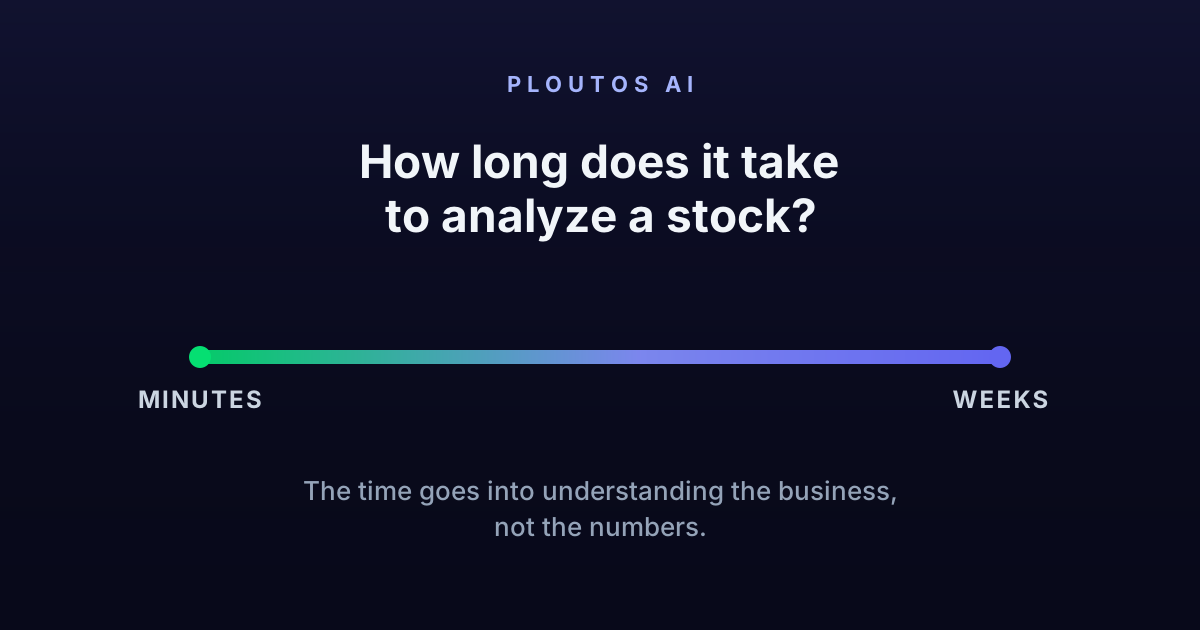
Ask ten investors how long it takes them to analyze a stock and you will get ten different answers. The most honest one usually sounds like this: "anywhere from a few minutes to several weeks, depending." And the whole point hides in that "depending".
The question is not how much time, but where the time goes. Because once you understand where it goes, you can cut the part that is merely tedious and keep the part that actually matters.
Why the time varies so much
Two things decide whether an analysis takes you ten minutes or ten days.
The first is how well you already know the industry. A software company that looks like five others you have worked through is fast. A biotech, an insurer, or a shipping company, if you have never touched the sector, takes time just to grasp what it actually sells and how it makes money.
The second is what decision you are trying to make. A quick "is this even worth a closer look?" is minutes. A "I am putting in a meaningful amount and holding for years" justifies weeks. Not every stock needs the same depth, and treating them all the same is the surest way to waste time.
Where the time actually goes
Here is the surprise: the time does not go into the numbers. Revenue, earnings, debt, margins, you find all of that in minutes. The real time goes into two things that no quick lookup solves.
The first is understanding exactly what the company does and where it makes money. It is easy to buy something you do not understand, then sell it on the first dip because you have no conviction about what you hold. Plenty of people have sold good stocks far too early for exactly this reason, not because they got the entry wrong, but because they had no clear picture of the business to hold through the noise.
The second is checking whether the numbers are real. Some companies massage things a little everywhere, in how they capitalise R&D, in depreciation, in adjusted earnings that conveniently make the ugly parts disappear. Spotting that takes time and experience, and it is exactly the part most people skip.
The 5-point quick scan
Before you dig deep, a fast filter saves hours. The goal is not to decide, but to quickly figure out whether it is worth continuing. Look at five things:
- Profitability. Does it earn consistent operating profit, or does it live on promises and narrative?
- Debt. Can it survive a bad year, or is it so leveraged that one wrong turn sends it into the wall?
- Cash flow. Do the earnings turn into actual cash, or do they sit on paper as receivables and accounting entries?
- Valuation. Are you paying a reasonable price for what you get, or pricing in a perfect future that has to play out exactly?
- Quality of the numbers. Are there signs something is being inflated? This is where ratios like Piotroski (fundamental quality), Altman Z (bankruptcy risk), and Beneish (possible manipulation) help.
If any of these flags a problem, you stop right there and save the weeks. That is the point of the quick scan, to let you say "no" fast, so you can spend your time where it is worth it.
The genuinely hard part
If it passes the filter, the hard part begins, and it is almost always the same: understanding the business well enough to know what you hold.
It is not the math. The math is time-consuming but not hard. The hard part is answering questions that have no ready-made number: why do customers pick this company over the next one? How easily could someone copy it? What has to happen for today's price to make sense? That "how hard is it to copy" is essentially the company's economic moat, and it is one of the most decisive pieces of the picture.
When you have clear answers to these, a 20% drop is an opportunity or a signal, not a reason to panic. When you do not, every move in the price scares you, because you cannot tell whether what you own changed or the market just had a bad day.
How to save time without losing depth
The key is not to read less. It is to automate the mechanical part, gathering and checking the data, and keep your time for the part that needs judgment, understanding the business and the risk scenarios.
That is where tools that read the official filings for you and surface a few understandable figures with the sources help, instead of leaving you to dig through hundreds of pages. With one condition: the numbers have to be real. A general-purpose language model often invents figures with total confidence, so a tool is only worth it if its data is pulled from a verifiable source, not from the model's "memory".
That is exactly the logic behind Ploutos AI: the mechanical part happens automatically and with citations, and the judgment part stays with you, with the "why" alongside the "what could go wrong". If you want to see how the stages fit together, there is a detailed walkthrough of the pipeline, or you can just run an analysis on a stock you know well and compare.
What this means for you
The right question is not "how much time does it take". It is "where is my time worth spending". A few minutes to quickly cut anything that does not hold up, and the bulk of your time where the real decision hides: understanding the business and confirming the numbers are real.
If you have those two clear, analysis stops being a chore and becomes conviction. And conviction is what keeps you in a good position when the market tests you.
Frequently asked questions
How long does it take to analyze a stock?
Anywhere from a few minutes to several weeks, depending on how well you already know the industry and what decision you are trying to make.
Where does the time actually go?
Not into the numbers. It goes into understanding exactly what the company does and where it makes money, and confirming the numbers are real.
How do I save time without losing depth?
Automate the mechanical part (gathering and checking data) and keep your time for the part that needs judgment.
Related reading
- How to read a 10-KWhat a 10-K is, where to find it, which parts to read first and what to look for in each. A guide to the annual filing US companies make with the SEC.
- Insider trades and Form 4: what they meanWhat Form 4 is, who counts as an insider, how to tell a real purchase from stock pay, and why an executive's sale usually says less than a purchase.
- ROIC and ROE: what they show and how they differReturn on invested capital (ROIC) and return on equity (ROE) explained simply: how they are calculated, why ROE is flattered by debt, and why ROIC says more about the quality of a business.
Important notice
This article is for general educational and informational purposes only. It is not investment advice and does not take into account your personal circumstances, objectives, or financial situation. Any security named is described for illustration and is not a recommendation to buy or sell.
Investing in stocks carries risk, including the possible loss of all invested capital. The past performance of any analysis, methodology, or strategy is not a reliable indicator of future results. Different investors reach different conclusions from the same information, depending on their objectives, time horizon, and risk tolerance.
You are solely responsible for your investment decisions. Before acting on any information from this site, you should assess whether it is appropriate for your circumstances and consult an appropriately qualified professional if you are in any doubt.
See the Terms for the full disclaimer and disclosures.
Try Ploutos AI on a ticker you're researching
Free tier includes 3 deep analyses per month. No credit card required.
Get started, it's free