How to read a 10-K: a US company's annual report, without getting lost
What a 10-K is, where to find it, which parts to read first and what to look for in each. A guide to the annual filing US companies make with the SEC.
Research, not advice. This guide is educational. It explains a methodology and is not a recommendation to buy or sell any security. Full disclosure at the end.
Once a year, every US listed company publishes a document that tells you almost everything you need to know about it: what it does, where it makes money, what could go wrong, and its audited financial numbers. It is called the 10-K, it is filed with the Securities and Exchange Commission (SEC), and it is free for anyone to read.
The problem is size. A large company's 10-K easily runs past 100 pages, and nobody reads it cover to cover. You do not need to. This article shows how it is organised, which parts to read first, and what to look for in each.
What a 10-K is and when it is filed
The 10-K is the company's annual report to the SEC. It is not the glossy "annual report" with photos that many companies mail to shareholders. It is the legal document, with a structure the SEC defines, and its financial statements have been audited by an independent accounting firm.
It is filed within 60 to 90 days of the end of the company's fiscal year, depending on its size: 60 days for the largest, 90 for the smallest. The fiscal year does not always match the calendar year. Many companies close their year in June or September.
Next to the 10-K are two other filings you will meet often:
- 10-Q: the quarterly report, three times a year. Shorter, with financial statements that have been reviewed but not fully audited.
- 8-K: filed within four business days when something important happens, such as results, an acquisition, a new CEO or a new loan.
Foreign companies listed in the US usually file a 20-F instead of a 10-K. The content is similar, but the structure differs and the numbers may follow international accounting standards (IFRS).
Where to find it
Every filing is on EDGAR, the SEC's public database (sec.gov). You search for the company by name or ticker and filter the filings by type "10-K". Most companies also post the same filings on the Investor Relations page of their website.
The financial numbers inside the filings are tagged in a machine-readable format (XBRL). That means every figure, such as revenue or debt, carries a label saying what it is and which period it covers. That is where Ploutos reads the financial figures it shows in every analysis, straight from the filing.
How it is organised
Every 10-K follows the same structure, split into four parts and numbered sections (Items). You do not need all of them. These matter most:
| Section | What it contains |
|---|---|
| Item 1, Business | What the company does, its segments, customers and competitors |
| Item 1A, Risk Factors | The risks the company itself sees |
| Item 3, Legal Proceedings | Significant lawsuits |
| Item 7, MD&A | Management's explanation of the year's results |
| Item 7A | Exposure to interest rates, currencies and commodity prices |
| Item 8, Financial Statements | The audited financial statements and their notes |
| Item 9A, Controls and Procedures | Whether the company's internal controls work |
Part III (management, pay, who owns the shares) often points to another document, the proxy statement (DEF 14A), filed before the annual meeting.
A reading order that works
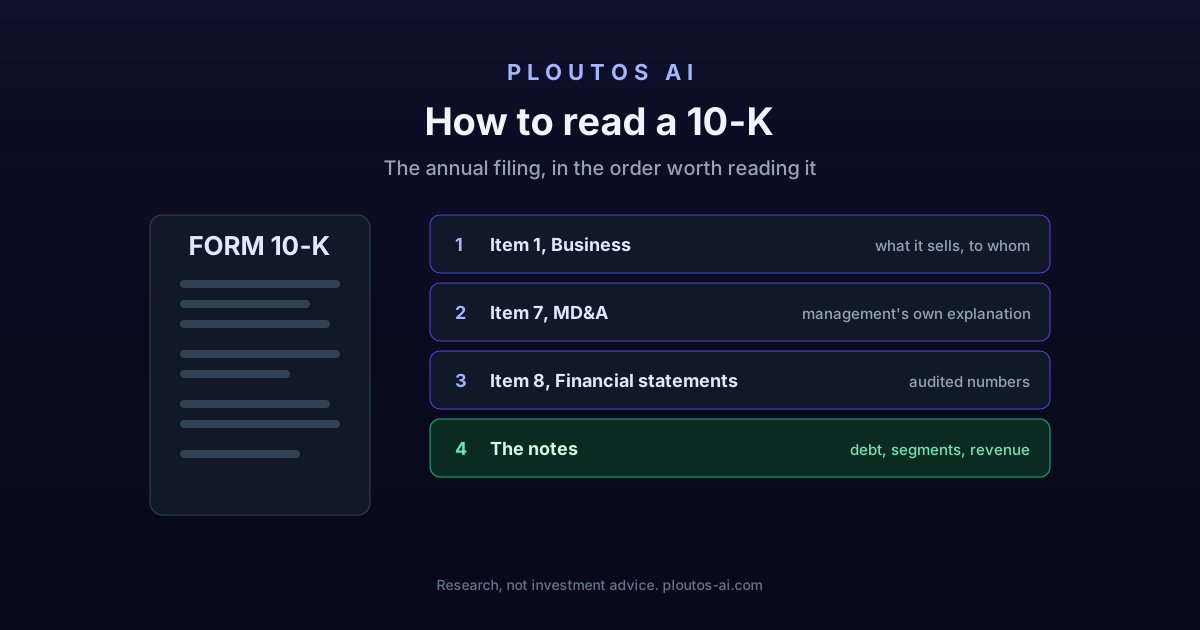
1. Start with Item 1 (Business). Before you look at a single number, understand what the company sells and to whom. Look at how it splits its business into segments and which segment brings in the most revenue. If you cannot explain in two sentences how it makes money, the rest will not make sense.
2. Then Item 7 (MD&A). Here management explains in its own words what happened during the year: why revenue rose or fell, what squeezed margins, how much cash it has and how it plans to use it. Remember the company wrote it. Read it, but check what it says against the numbers in Item 8. Be especially careful with "adjusted" (non-GAAP) figures, which leave out expenses the company considers one-off. Some are. Some come back every year.
3. Item 8 (financial statements). Three core statements: the income statement (revenue, expenses, profit), the balance sheet (what it owns and what it owes), and the cash flow statement (what cash came in and went out). Each shows at least two years side by side, so you see immediately what changed. For how cash flow complements earnings, see the article on free cash flow.
4. The notes. This is the part most people skip, and it is often where the most useful information sits. Three notes are worth finding in every 10-K:
- Debt: how much the company owes, at what interest rate, and when each loan comes due. A large loan maturing next year while rates are high is something you want to know.
- Segments: revenue and profit by segment. Often one segment carries the whole company.
- Revenue recognition: when the company books revenue. Changes here can shift revenue from one year to another.
5. The auditor's report. It sits at the start of Item 8. Most of the time it says everything is fine. Two things deserve attention, though: a going concern paragraph, which means the auditor doubts the company will make it through the next 12 months, and critical audit matters, the areas where the auditor had to exercise the most judgement.
6. Item 1A (risks), by comparison. The risk list is usually long and generic, because companies list everything that could go wrong to protect themselves legally. The useful part is not the list but its changes: a new risk that was not there last year, or one that grew, usually means something.
7. Item 9A, quickly. If you see the phrase "material weakness", the company or its auditor found a serious problem in how the financial numbers are produced. It does not mean the numbers are wrong, but it does mean you should trust them less.
Three practical tricks
- Compare with last year. Open last year's 10-K next to this year's. Changes in wording, risks and notes say much more than the text itself.
- Search for words. Instead of reading page by page, search the document for words like "impairment", "restatement", "covenant" and "customer concentration".
- Do not start from the press release. The results a company announces in its press release are written to look good. The 10-K is written to avoid legal trouble. When they disagree, trust the 10-K.
Why it is worth the effort
Most of what you read about a company, in the news, on forums or in analyses, is someone's interpretation of its 10-K. Once you can read it, you can check that interpretation yourself.
That is why the financial figures in Ploutos analyses, such as revenue, earnings, cash flow and debt, come from these filings, and where the data runs out the analysis says so instead of guessing. For why that matters, see the article on research tools that cite SEC filings. And to see an analysis built from a real company's 10-K, you can run one.
Frequently asked questions
What is a 10-K?
The annual report every US listed company files with the Securities and Exchange Commission (SEC). It contains a description of the business, its risks, management's explanation of the year and the audited financial statements.
Where do I find a company's 10-K?
On EDGAR, the SEC's free database, by searching for the company's name or ticker. Most companies also post it on the Investor Relations page of their website.
What is the difference between a 10-K, a 10-Q and an 8-K?
The 10-K is the annual report, with audited financial statements. The 10-Q is the quarterly report, shorter and not fully audited. An 8-K is filed within a few days when something important happens, such as an acquisition or the CEO leaving.
What do foreign companies listed in the US file?
Most file a 20-F instead of a 10-K. It covers similar ground, but often follows international accounting standards (IFRS) and is due within four months of the year end.
Related reading
- Insider trades and Form 4: what they meanWhat Form 4 is, who counts as an insider, how to tell a real purchase from stock pay, and why an executive's sale usually says less than a purchase.
- ROIC and ROE: what they show and how they differReturn on invested capital (ROIC) and return on equity (ROE) explained simply: how they are calculated, why ROE is flattered by debt, and why ROIC says more about the quality of a business.
- What is free cash flow (FCF)?What free cash flow is, where to find it in the cash flow statement, why it often differs from earnings, and what to check before you trust it.
Important notice
This article is for general educational and informational purposes only. It is not investment advice and does not take into account your personal circumstances, objectives, or financial situation. Any security named is described for illustration and is not a recommendation to buy or sell.
Investing in stocks carries risk, including the possible loss of all invested capital. The past performance of any analysis, methodology, or strategy is not a reliable indicator of future results. Different investors reach different conclusions from the same information, depending on their objectives, time horizon, and risk tolerance.
You are solely responsible for your investment decisions. Before acting on any information from this site, you should assess whether it is appropriate for your circumstances and consult an appropriately qualified professional if you are in any doubt.
See the Terms for the full disclaimer and disclosures.
Try Ploutos AI on a ticker you're researching
Free tier includes 3 deep analyses per month. No credit card required.
Get started, it's free