Free cash flow: the money that is really left over
What free cash flow is, where to find it in the cash flow statement, why it often differs from earnings, and what to check before you trust it.
Research, not advice. This guide is educational. It explains a methodology and is not a recommendation to buy or sell any security. Full disclosure at the end.
A company's earnings are the number you hear on the news. They are not the money in its bank account. One company can report a profit and still borrow to make payroll, while another reports a loss as its cash pile grows.
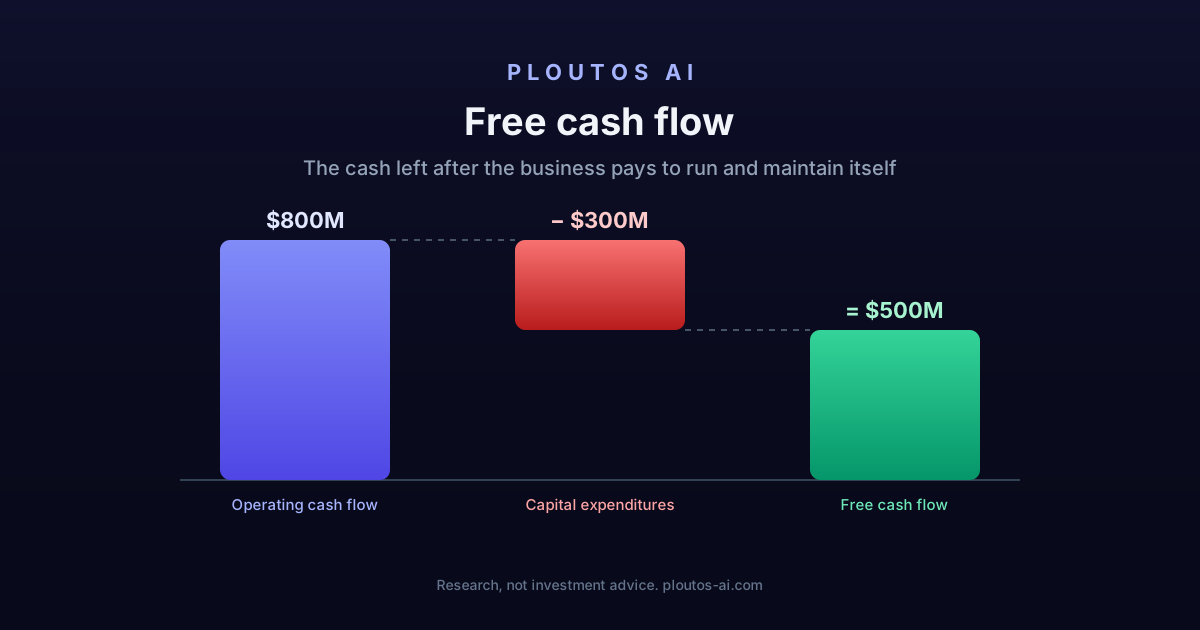
That is why many investors look first at free cash flow (FCF): the cash really left over after the company pays for everything it needs to keep operating. It is the money a company uses to pay dividends, buy back shares, pay down debt or invest to grow.
How it is calculated
The most common formula is simple:
Free cash flow = cash flow from operating activities − capital expenditures (capex)
Both numbers are in the cash flow statement, one of the three core financial statements every listed company publishes, along with the income statement and the balance sheet.
- Cash flow from operating activities (operating cash flow): the cash the company's normal business brought in during the year. It starts from net income and adjusts for everything that was not an actual payment or receipt.
- Capital expenditures (capex): the money spent on long-lived assets such as factories, machines, buildings and servers. In the cash flow statement it usually appears as "purchases of property and equipment".
An example: a company has operating cash flow of 800 million dollars and spends 300 million on new equipment. Its free cash flow is 500 million dollars.
Why earnings and cash differ
The gap between earnings and cash flow is not an error or a fraud. It comes from how accounting works. Three reasons explain most of it:
Depreciation. When a company buys a 10 million machine that will last ten years, accounting does not charge it all in the year of purchase. It spreads it: 1 million of expense a year, for ten years. That is depreciation. It lowers each year's earnings, but it is not a payment, because the money all went out in the first year. So in the cash flow statement depreciation is added back, and capex is subtracted when it is actually paid.
Working capital. If a company sells on credit, the revenue goes into earnings right away, but the cash arrives when the customer pays. If it buys inventory it has not sold yet, the cash has gone out but the expense has not been recorded. When receivables and inventory grow faster than sales, earnings pull away from cash.
Non-cash expenses. The most common example is stock-based compensation. The company pays part of its salaries in new shares. It counts as an expense in earnings, but it is added back in cash flow because no cash left the company.
What to check before you trust the number
Free cash flow is harder to dress up than earnings, but it is not foolproof. Five things are worth checking:
1. Stock-based compensation. At many tech companies stock-based pay is a large number. It is added back to cash flow, so free cash flow looks bigger. But every new share shrinks the slice of the company you own. A conservative approach is to subtract stock-based compensation from free cash flow, as if it were an ordinary expense.
2. One good year is not enough. Working capital can make a single year's cash flow look much better or much worse than normal. A company that delayed paying its suppliers at year end will show inflated cash flow. Always look at several years together.
3. Maintenance capex and growth capex. Part of capex is needed just to keep the business where it is. The rest goes into growth. Companies rarely separate the two in their filings. A company investing heavily to grow will have low free cash flow today, and that is not necessarily a bad sign.
4. Acquisitions. The money a company spends buying other companies usually does not count as capex. A company that grows mainly through acquisitions can show high free cash flow while spending a lot of cash every year to keep growing.
5. Leases. For some leases, part of the payments is recorded in financing cash flow rather than operating cash flow. That happens with finance leases under US accounting rules (US GAAP), and with nearly all leases under international rules (IFRS), which many foreign companies listed in the US follow. At companies with many leased stores, aircraft or equipment, this makes free cash flow look larger than it would if rent counted as an ordinary expense.
How it is used in analysis
Free cash flow shows up in almost every serious stock analysis, in three ways:
As a check on earnings. If earnings rise year after year but cash flow does not, something is off: customers are paying more slowly, inventory is piling up, or earnings include revenue that has not turned into cash. When the two numbers move together over many years, the earnings are more trustworthy.
As a valuation measure. Free cash flow yield is free cash flow per share divided by the price. A yield of 6% means the company produces 6 dollars of cash for every 100 you pay for its stock. It works like the inverse of the P/E ratio, but with cash instead of accounting earnings.
As the basis for fair value. A discounted cash flow valuation starts right here: it projects free cash flow into the future and brings it back to its present value. If the starting number is inflated, the whole valuation is inflated. More in the article on DCF valuation.
In short
Earnings tell you what the accounting says. Free cash flow tells you what was left in the bank. Neither is enough on its own, but when they disagree for years, the cash is usually right.
These numbers are in every company's annual filing. If you want to see exactly where, the article on how to read a 10-K shows the way. And if you want to see earnings and cash flow side by side for a real company, you can run an analysis.
Frequently asked questions
What is free cash flow?
The cash a company has left after paying for everything it needs to run and maintain its business. It is calculated as cash flow from operating activities minus capital expenditures (capex).
Why does free cash flow differ from earnings?
Because earnings are an accounting number. They include expenses that are not payments, such as depreciation, and revenue that has not been collected yet. Cash flow counts only the cash that actually came in and went out.
Is negative free cash flow bad?
Not always. A company investing heavily to grow can run negative cash flow for a few years. It becomes a problem when it stays negative for years with no clear path back, and the company covers the gap with debt or new shares.
What is free cash flow yield?
Free cash flow per share divided by the share price. It shows how much cash the company produces for every 100 dollars you pay for its stock.
Related reading
- How to read a 10-KWhat a 10-K is, where to find it, which parts to read first and what to look for in each. A guide to the annual filing US companies make with the SEC.
- Insider trades and Form 4: what they meanWhat Form 4 is, who counts as an insider, how to tell a real purchase from stock pay, and why an executive's sale usually says less than a purchase.
- ROIC and ROE: what they show and how they differReturn on invested capital (ROIC) and return on equity (ROE) explained simply: how they are calculated, why ROE is flattered by debt, and why ROIC says more about the quality of a business.
Important notice
This article is for general educational and informational purposes only. It is not investment advice and does not take into account your personal circumstances, objectives, or financial situation. Any security named is described for illustration and is not a recommendation to buy or sell.
Investing in stocks carries risk, including the possible loss of all invested capital. The past performance of any analysis, methodology, or strategy is not a reliable indicator of future results. Different investors reach different conclusions from the same information, depending on their objectives, time horizon, and risk tolerance.
You are solely responsible for your investment decisions. Before acting on any information from this site, you should assess whether it is appropriate for your circumstances and consult an appropriately qualified professional if you are in any doubt.
See the Terms for the full disclaimer and disclosures.
Try Ploutos AI on a ticker you're researching
Free tier includes 3 deep analyses per month. No credit card required.
Get started, it's free