ROIC and ROE: how well a company puts its money to work
Return on invested capital (ROIC) and return on equity (ROE) explained simply: how they are calculated, why ROE is flattered by debt, and why ROIC says more about the quality of a business.
Research, not advice. This guide is educational. It explains a methodology and is not a recommendation to buy or sell any security. Full disclosure at the end.
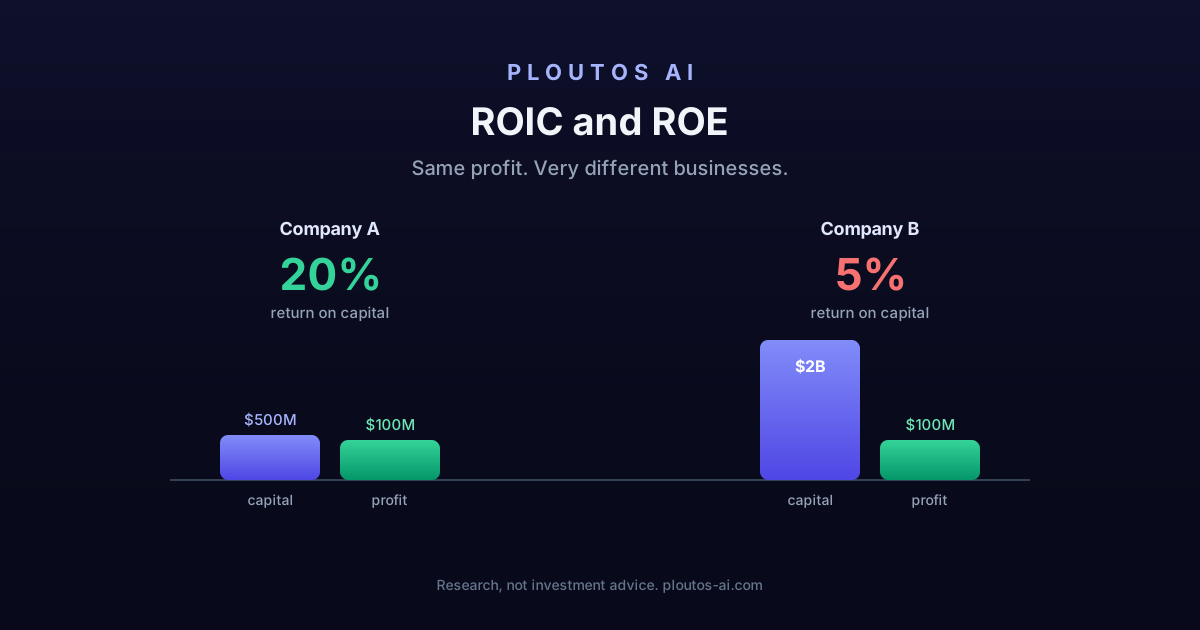
Two companies each earn 100 million dollars a year. The first needed 500 million to build the business that earns it. The second needed 2 billion. In the news both are "companies earning 100 million". To an investor they are two completely different businesses.
The first earns 20 cents for every dollar it has put in. The second earns 5. If they want to grow, the first needs little money for each new dollar of profit, the second a lot. Two ratios measure that difference: ROE and ROIC. They look alike, but one is easily fooled and the other is not.
ROE: return on equity
ROE (return on equity) = net income ÷ shareholders' equity
Shareholders' equity is what is left when you subtract everything a company owes from everything it owns. In accounting terms, it is the part of the business that belongs to the shareholders. ROE answers the question: for every dollar of shareholders' money in the company, how much profit came out this year?
A company with net income of 150 million and equity of 1 billion has a ROE of 15%. The denominator is usually the average of equity at the start and end of the year, because the profit was earned across the whole year.
The problem with ROE: debt
ROE has one big blind spot. It rises when the company borrows.
Imagine two identical companies, with the same business and the same operating profit. One was funded only by its shareholders. The other also took a large loan and returned money to its shareholders. The second now has much less equity. After paying interest its profit is slightly lower, but it is divided by a much smaller number. Its ROE comes out far higher, while the business is exactly the same, only riskier.
The so-called DuPont analysis shows this clearly by splitting ROE into three parts:
ROE = profit margin × asset turnover × assets to equity
The first part shows how much the company earns on each sale. The second how many sales it generates from what it owns. The third how much it relies on other people's money, mostly debt. A high ROE that comes from the first two is a good sign. A high ROE that comes mainly from the third just means a lot of borrowing.
There is also an extreme case: companies that have bought back so many shares, or borrowed so much, that their equity is negative. There ROE comes out negative or enormous and tells you nothing at all.
ROIC: return on invested capital
ROIC solves that problem, because it counts all the capital working in the business, whether it came from shareholders or lenders.
ROIC (return on invested capital) = after-tax operating profit ÷ invested capital
- After-tax operating profit (NOPAT): the profit from the company's normal business, before interest, after tax. It is not affected by how much debt the company carries.
- Invested capital: a common way to calculate it is equity plus debt minus the cash not needed to run the business.
Because it counts shareholders' and lenders' money together, ROIC shows how good the business itself is, regardless of how it was funded. The two identical companies in the example above would have roughly the same ROIC, however different their ROE.
There are several ways to calculate ROIC, and different sources give different numbers for the same company. That is fine, as long as you compare numbers calculated the same way.
Why ROIC matters so much
It shows whether growth creates value. All capital has a cost: lenders want interest, shareholders want a return worth the risk. If a company earns a ROIC of 6% and its capital costs 9%, every new dollar it invests destroys value, however fast revenue grows. If it earns 25%, every new dollar creates a lot of value. Growth is only good when ROIC is above the cost of capital.
It shows competitive advantage. In a competitive market, high returns attract competitors, and competitors drive returns down. A company that keeps a high ROIC for ten years has something others cannot copy. That is called a moat, and ROIC is one of its clearest fingerprints, as the article on the economic moat explains.
Duration matters more than height. A ROIC of 40% for one year says little. A ROIC of 18% that stays there for ten years, through good years and bad, says a lot. Always look at the trend, not a single value.
What to watch for
Acquisitions and goodwill. When a company buys another above its book value, the difference is recorded as goodwill and inflates invested capital. So a company that grew through acquisitions shows a lower ROIC. Some people calculate ROIC without goodwill too: that shows how good the business is, while ROIC with goodwill shows how well management spent money on acquisitions.
Banks and insurers. For a bank, loans and deposits are not funding, they are the raw material of the business. ROIC does not make sense there. For banks you look at ROE and return on assets (ROA), together with how much of its own capital the bank holds to absorb losses.
Asset-light companies. Software or services companies can show a huge ROIC, because their biggest "investment" is in people and research, which accounting records as expenses rather than capital. The high ROIC is real, but it is not directly comparable with a manufacturer's.
One year with special events. A large write-off can suddenly shrink capital and artificially lift ROIC in the following years. As with any ratio, check what happened before you trust a number that changed abruptly.
In short
ROE tells you how much shareholders earn for every dollar of theirs in the company, but it also rises with debt. ROIC tells you how good the business itself is, however it was funded. When you see a high ROE, ask where it comes from. When you see a high ROIC, ask how many years it has lasted.
If you want to see how they read alongside the rest of a real company's numbers, you can run an analysis.
Frequently asked questions
What is ROE?
Return on equity: net income divided by the company's shareholders' equity. It shows how much profit the company makes for every dollar that belongs to its shareholders.
What is ROIC?
Return on invested capital: after-tax operating profit divided by all the capital invested in the business, from shareholders and lenders together.
What is the key difference between ROE and ROIC?
ROE rises when a company borrows more, because equity shrinks relative to the size of the business. ROIC counts all the capital, borrowed and owned, so debt does not flatter it.
What counts as a good ROIC?
One that stays consistently above the company's cost of capital, meaning the return its shareholders and lenders require. A ROIC that stays high for many years is usually a sign of a competitive advantage.
Related reading
- How to read a 10-KWhat a 10-K is, where to find it, which parts to read first and what to look for in each. A guide to the annual filing US companies make with the SEC.
- Insider trades and Form 4: what they meanWhat Form 4 is, who counts as an insider, how to tell a real purchase from stock pay, and why an executive's sale usually says less than a purchase.
- What is free cash flow (FCF)?What free cash flow is, where to find it in the cash flow statement, why it often differs from earnings, and what to check before you trust it.
Important notice
This article is for general educational and informational purposes only. It is not investment advice and does not take into account your personal circumstances, objectives, or financial situation. Any security named is described for illustration and is not a recommendation to buy or sell.
Investing in stocks carries risk, including the possible loss of all invested capital. The past performance of any analysis, methodology, or strategy is not a reliable indicator of future results. Different investors reach different conclusions from the same information, depending on their objectives, time horizon, and risk tolerance.
You are solely responsible for your investment decisions. Before acting on any information from this site, you should assess whether it is appropriate for your circumstances and consult an appropriately qualified professional if you are in any doubt.
See the Terms for the full disclaimer and disclosures.
Try Ploutos AI on a ticker you're researching
Free tier includes 3 deep analyses per month. No credit card required.
Get started, it's free