Insider trading and Form 4: what it means when an executive buys or sells their company's stock
What Form 4 is, who counts as an insider, how to tell a real purchase from stock pay, and why an executive's sale usually says less than a purchase.
Research, not advice. This guide is educational. It explains a methodology and is not a recommendation to buy or sell any security. Full disclosure at the end.
Nobody knows a company better than the people running it. So when a CEO buys their company's stock with their own money, investors notice. And when they sell, investors worry.
In the US these trades are public, just days after they happen. They are reported on an SEC form called Form 4. The problem is that most transactions on a Form 4 are not what they look like. This article explains who files, how to separate the trades that matter from the rest, and why a purchase usually says much more than a sale.
Who the insiders are
US law defines three groups who must report every trade in the company's stock:
- officers (the CEO, the chief financial officer and the other senior executives),
- directors on the board,
- anyone owning more than 10% of the company's shares.
When someone becomes an insider, they file a Form 3 listing what they own. After that, every change is reported on a Form 4, within two business days of the trade. All of it is public on EDGAR, the SEC's database.
One clarification: "insider trading" means two different things in English. One is illegal: trading on information that has not been made public. The other is perfectly legal: the reported trades of the company's own people. This article is about the second.
Most transactions are not purchases or sales
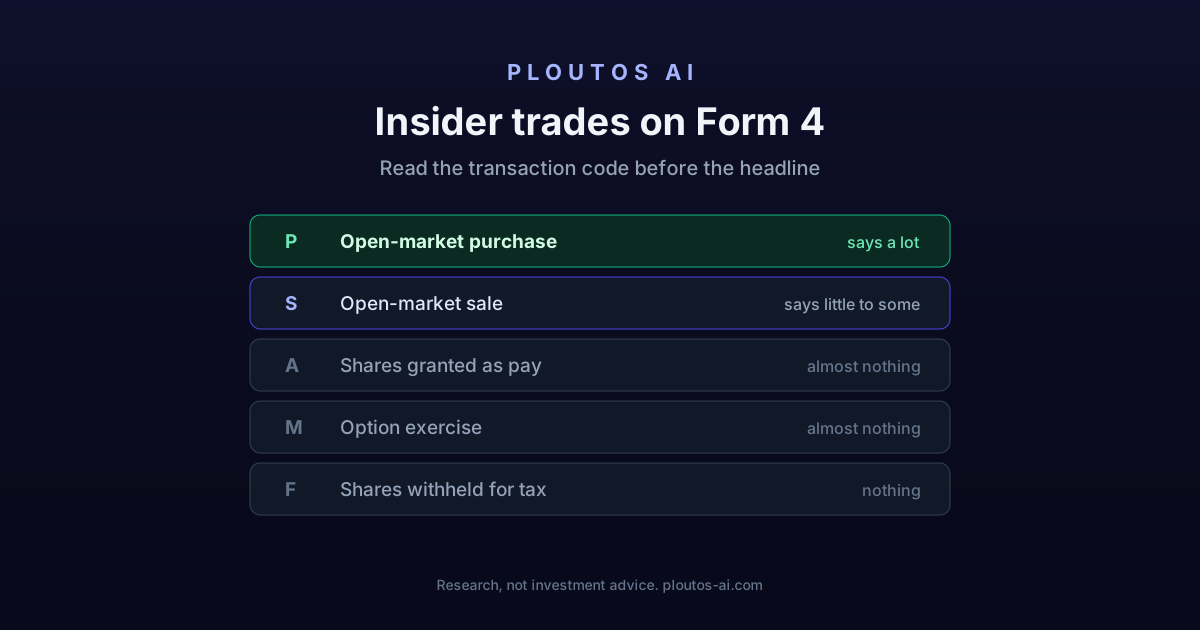
Every line on a Form 4 carries a transaction code, a letter saying what happened. It is the single most important thing for reading a Form 4 correctly, because most lines are not decisions by the insider to buy or sell.
| Code | What it means | How much it says |
|---|---|---|
| P | Open-market purchase, with their own money | A lot |
| S | Open-market sale | Little to some |
| A | Shares granted as pay | Almost nothing |
| M | Exercise of options | Almost nothing on its own |
| F | Shares withheld by the company to pay the tax | Nothing |
| G | Gift | Nothing |
An example you will see often: an executive exercises options (M), the company withholds some shares for the tax (F), and they sell the rest (S), all on the same day. A hasty reader sees "the executive sold 50,000 shares". In reality they cashed in part of their pay, as they do every year.
Why purchases matter more than sales
An insider sells for many reasons unrelated to where the company is heading: to pay taxes, to buy a house, to avoid having their whole fortune in one stock. Senior executives receive a large part of their pay in stock, so it is natural for them to sell regularly.
A purchase is different. Someone who already has much of their wealth tied up in the company, and puts in more from their own pocket, usually does it for one reason: they believe the stock is worth more than its price. Many academic studies have found that insider purchases were followed, on average, by better returns than insider sales. On average, though, not every time.
Three things make a purchase more meaningful:
- Several at once (cluster buying). When three or four executives buy within the same few weeks, it is much harder to be a coincidence.
- Size relative to the person. A 50,000 dollar purchase by a CEO paid 10 million a year says little. A 2 million purchase says a lot.
- Who is buying. The CEO and the chief financial officer see the numbers first. Their purchases usually count for more than those of an independent director.
When a sale deserves attention
Sales say less, but not nothing. They are worth a look when:
- several insiders sell together, especially outside their usual selling season,
- an insider sells a large share of their holding, not a small slice,
- the sale was not scheduled.
The last point needs explaining. Many insiders sell through a 10b5-1 plan: they decide in advance, while they have no inside information, when or at what price they will sell. Since 2023 the rules are stricter. There is a mandatory waiting period between setting up the plan and the first trade, and Form 4 shows whether a trade was made under such a plan. A sale under a 10b5-1 plan was designed months earlier and says very little about what the insider thinks today. A sale outside a plan says more.
The limits of the signal
Insider trades are useful information, not a guide.
- Insiders get it wrong. They know their company, not where the market or the economy is going. Plenty bought their company's stock shortly before it fell further.
- Some purchases are for show. A small purchase after bad news can be management's way of signalling confidence, more than a real investment.
- Large companies see few purchases. At very large companies executives rarely buy in the open market, because they already receive a lot of stock as pay. The absence of purchases there means nothing.
That is why insider trades are read together with everything else: the company's numbers, its valuation, its risks. A similar signal, with similar limits, is the positions of large institutional investors, explained in the article on 13F filings and smart money.
How to see them
Every Form 4 is free on EDGAR, on each company's page, filtered by form type "4". When reading one, look at the transaction code first and the amount second.
Ploutos analyses read Form 4 filings straight from the SEC and separate the transactions by code, so an option exercise or a tax withholding does not count as a decision to buy or sell. If you want to see how they look for a real company, alongside the rest of its picture, you can run an analysis.
Frequently asked questions
What is Form 4?
The filing that officers, directors and holders of more than 10% of a US listed company must submit to the SEC every time they buy or sell its stock. It is due within two business days.
Is it illegal for an insider to buy or sell shares?
No. It is legal, as long as they do not trade on material information that has not been made public, and they report it. Form 4 exists precisely so these trades are public.
Why are insider purchases considered more meaningful than sales?
Because an insider sells for many reasons: taxes, a house, diversifying their wealth. They usually buy with their own money for one reason, because they believe the stock is worth more.
What is a 10b5-1 plan?
A trading plan the insider sets up in advance, with dates or prices, while not in possession of inside information. Sales under such a plan are usually scheduled months ahead and say little about the insider's view today.
Related reading
- How to read a 10-KWhat a 10-K is, where to find it, which parts to read first and what to look for in each. A guide to the annual filing US companies make with the SEC.
- ROIC and ROE: what they show and how they differReturn on invested capital (ROIC) and return on equity (ROE) explained simply: how they are calculated, why ROE is flattered by debt, and why ROIC says more about the quality of a business.
- What is free cash flow (FCF)?What free cash flow is, where to find it in the cash flow statement, why it often differs from earnings, and what to check before you trust it.
Important notice
This article is for general educational and informational purposes only. It is not investment advice and does not take into account your personal circumstances, objectives, or financial situation. Any security named is described for illustration and is not a recommendation to buy or sell.
Investing in stocks carries risk, including the possible loss of all invested capital. The past performance of any analysis, methodology, or strategy is not a reliable indicator of future results. Different investors reach different conclusions from the same information, depending on their objectives, time horizon, and risk tolerance.
You are solely responsible for your investment decisions. Before acting on any information from this site, you should assess whether it is appropriate for your circumstances and consult an appropriately qualified professional if you are in any doubt.
See the Terms for the full disclaimer and disclosures.
Try Ploutos AI on a ticker you're researching
Free tier includes 3 deep analyses per month. No credit card required.
Get started, it's free