Stock research tools that cite SEC filings: what "cites the filing" actually means, tool by tool
Eight tools say their numbers come from SEC filings. They mean three different things. Where each one's figures actually come from, what a citation points to, and what each covers, checked on the vendors' own pages in September 2026.
Research, not advice. This guide is educational. It explains a methodology and is not a recommendation to buy or sell any security. Full disclosure at the end.
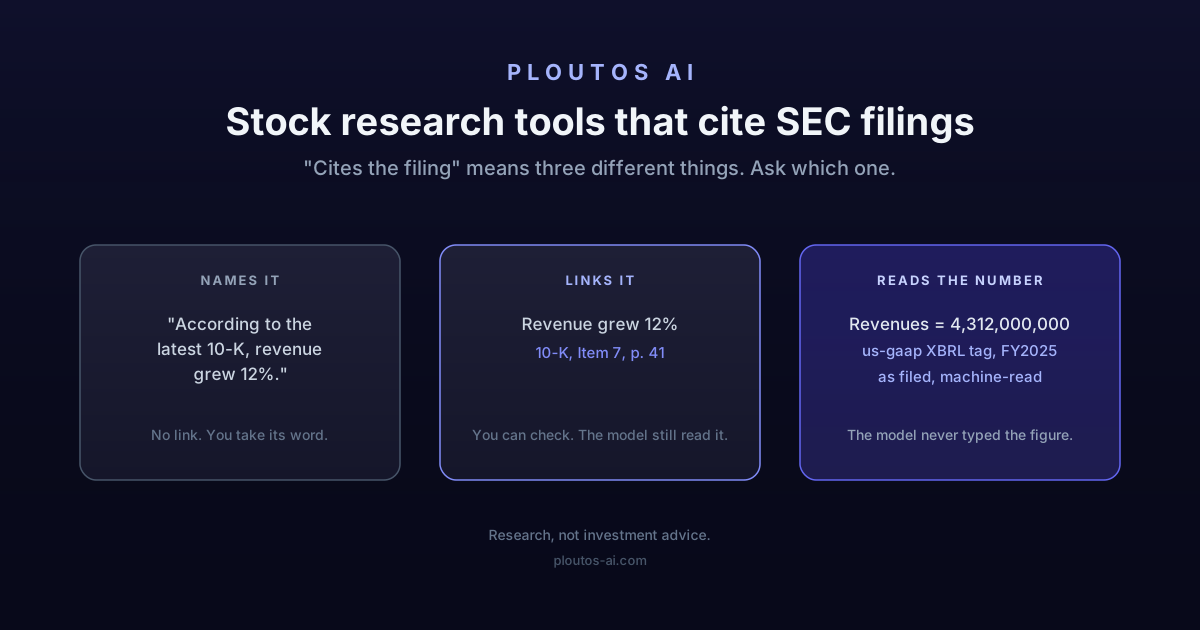
"Grounded in SEC filings." "Every figure cited to its source." "Click through to the filing." Almost every research tool built in the last two years says something like this, and the phrases sound interchangeable. They are not. Three very different mechanisms hide behind the same sentence, and which one a tool uses decides whether its numbers are checkable, or merely sound checkable.
This is a comparison of eight tools, plus the free baseline they all sit on, with every claim taken from the vendor's own website in September 2026. Ploutos AI is one of the eight, and the same rules apply to it as to the rest, including the part where it says what it does not do.
Three things "cites the filing" can mean
It names the filing. The answer says "according to the latest 10-K, revenue grew 12%." There is no link. The language model may well have read the 10-K, or may have read a news article about it, or may have produced the most plausible sentence. You cannot tell which, and the failure mode is well documented.
It links to the filing. The same sentence carries a link: to the document, to a section, or in the best case to the exact passage. Now you can check. But the number in the sentence was still read by the model out of prose or out of an HTML table, and the model can misread a table just as a person can. The link tells you where to look, not that the figure is right.
It reads the number from the filing's structured data. Every 10-K and 10-Q comes with an XBRL layer: each figure on the financial statements carries a machine-readable tag, the period it belongs to, and the unit. A tool that pulls Revenues for fiscal 2025 from that layer has a number the company itself tagged, and the language model never typed it. The model reasons about the figure; it does not produce it. This is the strongest form, and it is also the one vendors describe least clearly, because it is plumbing rather than a feature.
A fourth question sits underneath all three: is the number from the filing at all, or from a data vendor who read the filing and standardised it? Standardised data is not wrong, it is often more comparable across companies, but "from SEC filings" is then true of the vendor, not of the tool.
The free baseline: SEC EDGAR itself
Everything below is built on the SEC's own systems, and they are free.
- Full-text search covers every filing submitted electronically since 2001, including exhibits. Boolean and phrase queries only; the SEC states plainly that natural-language search is not supported.
- The XBRL APIs. The
companyfactsendpoint returns every tagged figure a company has ever reported, from 10-K, 10-Q, 8-K, 20-F, 40-F and 6-K forms, in one JSON file. No authentication, no key, updated within a minute of the filing, with a documented limit of 10 requests per second and a required User-Agent header. - Financial Statement Data Sets, quarterly bulk files of the same numbers, from 2009 to today, "as filed."
Two things the free layer does not cover: Form 4 insider transactions and 13F institutional holdings are not in the XBRL APIs. They are separate feeds with their own structure, which is why tools that offer them had to do extra work.
If you want to check a number yourself and have an afternoon, this is where you go. Every tool below is selling you the afternoon.
The eight tools
Prices and plans are left out on purpose: they change faster than an article does, and every vendor's pricing page is one click away. The mechanism is what matters.
AlphaSense, with BamSEC
AlphaSense is the institutional platform: 500 million documents, filings from 68,000 companies worldwide, broker research, transcripts. Its citation claim is the most specific in this list: "every AI-generated insight links directly to the exact sentence in the source document." That is level two at its best, sentence-level, and their developer API shows inline markers that resolve to the source.
Numbers come from a different route. Since October 2025 the platform carries financial data built on Canalyst models, "4,500+ ready-to-use models," and every figure keeps an audit link to the original source. Whether a number inside a chat answer came from a model field or from text is not stated.
BamSEC, which AlphaSense acquired through Tegus in 2024, is the opposite kind of tool: no language model at all. It is a reader for 10-Ks, 10-Qs, proxies and transcripts, with tables that "come straight from the filings with no modifications," one-click Excel export, and human-made links to a selected passage or table.
AlphaSense is sold to hedge funds, banks and corporates. Its help centre lists Greek among 37 languages for filtering non-English documents, but the interface is English.
Fiscal.ai, formerly FinChat
Fiscal.ai renamed from FinChat after a 10 million dollar Series A and now positions itself as "financial data infrastructure" with a research terminal on top. Its claim: "Source to Filing. Click-through auditability for every figure. Delivered in Image, PDF and URLs." A number links to the filing page it was taken from.
Where the number came from is stated more clearly than most: for US, Canadian, UK and EU companies plus ADRs the data is Fiscal.ai's own extraction "with human analyst verification," updated within minutes of earnings; for other geographies it is S&P Capital IQ. XBRL is not mentioned anywhere on the site. AI summaries got "citation support" in May 2026; the granularity of a chat citation is not described.
Coverage is 100,000 companies globally. Filing click-through and as-reported statements are on the top plan only. English primarily.
Equibles and ALVIS
Equibles is the smallest company here and the one whose methodology page answers the structured-versus-text question directly: "Fundamentals come from tagged XBRL, the company's own numbers." Narrative items, KPIs and non-GAAP bridges are extracted from the written filing, checked by "an independent verifier," and carry the verbatim source quote. Each figure carries the form, filing date and period it came from.
It is US-listed only, including foreign issuers that file 20-F and 6-K. The corpus covers 10-K, 10-Q, 8-K, 13F, Forms 3, 4 and 5, 13D and 13G. ALVIS is the chat layer, "a citation for every figure." The MCP server is open source and connects to Claude and ChatGPT.
Its own terms are unusually candid: AI responses "can be incomplete, outdated, or incorrect even when they include citations."
StockPortfolio.pro
StockPortfolio.pro promises "every figure cited to its SEC filing" and "no estimates." The metrics are computed deterministically from filed statements, "no AI judgement," rebuilt nightly. It reads 10-K, 10-Q, 8-K, 13F and Form 4.
The citation is at the filing level, not the figure or section level. In practice a stock page says "Source: Apple Inc. SEC filings (10-K)," and the public claim ledger links most rows to an EDGAR search page for the ticker rather than to a document. Whether extraction is XBRL or text is not stated. Coverage is US companies reporting in dollars, with limited ADR support.
English, plus a Simplified Chinese interface.
Last10K
Last10K is a filing reader with summaries, not a chat tool. Each filing page links back to the document on sec.gov, offers a table of contents by section, and a year-over-year "track changes" view showing what the company added, removed or reworded. Highlights are tagged by theme but do not cite item numbers or pages.
There is no AI answer feature, so there is nothing to hallucinate; the trade-off is that the reading is still yours. English.
Simply Wall St
Simply Wall St is the most popular retail platform on this list, seven million registered users, and it does not cite filings. "All of our data comes from S&P Global Market Intelligence," whose upstream sources include EDGAR. Figures carry the S&P attribution, and the help centre tells you to verify against the regulator's filings yourself.
That is not a criticism of the data; it is a description of the mechanism. Numbers are vendor-standardised, presented as trailing twelve months, and the analysis model is public on GitHub. Coverage is 120,000 stocks in 90 markets. English, Japanese, German, Spanish and Korean.
TIKR
TIKR sits on S&P Capital IQ and Morningstar, with Financial Modeling Prep as a secondary set. The support pages say it directly: line items "can be recategorized by CapitalIQ for better comparability." Filings and ownership data are available as tools inside the terminal; 13F tracking goes "beyond just 13F filings" to global disclosures from 10,000 investors.
Its AI product, Research Hub, is a beta on the Ultimate plan covering "a curated set of 100 names," with the disclaimer that it "uses auto-generated content which can have mistakes." No citation claim is made. The plan without global coverage is US-only. English.
Fintool
Fintool belongs in this list for what it claimed and for what happened to it. Through early 2026 it advertised page-level citations, "Apple Inc. Form 10-K (2023), Page 23, verified by 3/3 agents," an XBRL parser feeding a language model, and coverage of 8,000 US companies with filings indexed within a minute. It was sold to investment professionals.
In April 2026 the founder announced that the team and IP had joined Microsoft. As of September 2026 every page on fintool.com redirects to Microsoft 365. There is nothing to sign up for.
Ploutos AI
Ploutos AI is ours, so here is the same set of facts in the same order.
Numbers come from the SEC's structured XBRL data, the companyfacts layer described above, not from the model. The model is handed the figures and reasons about them; when the data is not there it stops rather than guesses. Insider transactions from Form 4, material events from 8-K filings and the quality flags they trigger link to the exact filing on EDGAR. Derived figures do not link anywhere: a fair value estimate, a ten-year average or a trailing sum is built from several filings and no single document states it, so putting a link on it would be decoration. The method is stated instead.
After the analysis is written, a separate Devil's Advocate pass argues the bear case in writing, and it is published next to the bull case. The pipeline is described in full.
Coverage is US-listed stocks only, NYSE, NASDAQ and AMEX. No earnings-call transcripts, no broker research, no non-US listings. Output in English or Greek. Research, not investment advice.
Side by side
| Tool | Where the numbers come from | What a citation points to | Coverage |
|---|---|---|---|
| SEC EDGAR | The filing's XBRL, as filed | The document itself | All SEC filers |
| AlphaSense | Canalyst models plus text | The exact sentence | 68,000 companies, global |
| BamSEC | Tables straight from filings | A passage or table you pick | SEC filers |
| Fiscal.ai | Own extraction, human-checked; S&P Capital IQ outside US/CA/UK/EU | The filing page, on Max | 100,000 companies, global |
| Equibles | Tagged XBRL; verified text extraction with quote | Form, date, period and quote per figure | US-listed |
| StockPortfolio.pro | Computed from filed statements, method unstated | The filing, or an EDGAR search | US, USD reporters |
| Last10K | The filing, read by you | The document on sec.gov | SEC filers |
| Simply Wall St | S&P Global Market Intelligence | Nothing; verify yourself | 120,000 stocks, global |
| TIKR | S&P Capital IQ, Morningstar, FMP | None claimed | 100,000 stocks, global |
| Fintool | XBRL parser plus text, historically | Filing and page, historically | 8,000 US companies, historically |
| Ploutos AI | SEC XBRL companyfacts | Exact filing for Form 4, 8-K, quality flags; none for derived figures | US-listed |
How to read this table
If your question is "can I check this number," the column that matters is the third one, and the honest answer for most tools is "you can check the document, not the number." Sentence-level links, which AlphaSense claims and Equibles approximates with quotes, are the exception.
If your question is "did a language model type this number," the column that matters is the second one. Equibles says XBRL. Ploutos AI says XBRL. Fiscal.ai says human-verified extraction. Fintool said XBRL and no longer exists. Everyone else is either a reader, a vendor feed, or does not say.
If your question is "which one should I use," this article does not answer it, on purpose. The mechanisms are different because the jobs are different. A reader like Last10K or BamSEC is for people who will do the reading. A vendor-fed terminal like TIKR or Simply Wall St is for people who want comparable numbers across a hundred markets and are fine trusting S&P to have read the filing. The citation-first tools, Equibles, Fiscal.ai, StockPortfolio.pro and Ploutos AI, are for people who want the number and the way to check it in the same place, and they differ mainly in geography and language.
Whatever you use, ask it the question this article is built on: when you show me a number, did you read it, or did you look it up? A tool that cannot answer that is naming the filing, not citing it.
Frequently asked questions
What does it mean when a stock research tool says it cites SEC filings?
One of three things. It names the filing in the text, it links to the filing or to a passage in it, or it reads the number from the filing's structured XBRL data so the language model never types the figure. Most tools do the first, several do the second, few say clearly whether they do the third.
Which tools link every figure back to the filing?
Fiscal.ai and Equibles state this on their own pages, and AlphaSense links each AI sentence to the source passage. StockPortfolio.pro links at the filing level. Ploutos AI links insider transactions, 8-K events and quality flags to the exact filing, but not derived figures such as fair value.
Is there a free way to get the numbers straight from SEC filings?
Yes. The SEC's own XBRL API returns every figure a company has tagged in its 10-K and 10-Q filings, free, without an API key, updated within a minute of the filing. It is what several of these tools are built on.
Do any of these tools work in Greek?
Ploutos AI produces its analysis in Greek and English. Simply Wall St has Japanese, German, Spanish and Korean. The others are English only.
Related reading
- How we track our own track recordMost stock pickers quietly bury their misses. Here is how Ploutos AI records every pick at decision time and benchmarks it against the market, openly.
- Why AI stock tools hallucinateA language model will happily invent a P/E ratio or an insider trade that never happened. Here is why it happens, and how Ploutos AI prevents it.
- Why we refuse to analyze a stockIncomplete data produces a confident but misleading verdict. Here is how Ploutos AI checks data coverage before spending your analysis, and when it stops.
Important notice
This article is for general educational and informational purposes only. It is not investment advice and does not take into account your personal circumstances, objectives, or financial situation. Any security named is described for illustration and is not a recommendation to buy or sell.
Investing in stocks carries risk, including the possible loss of all invested capital. The past performance of any analysis, methodology, or strategy is not a reliable indicator of future results. Different investors reach different conclusions from the same information, depending on their objectives, time horizon, and risk tolerance.
You are solely responsible for your investment decisions. Before acting on any information from this site, you should assess whether it is appropriate for your circumstances and consult an appropriately qualified professional if you are in any doubt.
See the Terms for the full disclaimer and disclosures.
Try Ploutos AI on a ticker you're researching
Free tier includes 3 deep analyses per month. No credit card required.
Get started, it's free