Smart money: what 13F filings show, and how to read them properly
What 13F filings are, what smart-money and insider signals actually tell you (and what they don't), and how to read them as a research starting point, not a buy command.
Research, not advice. This guide is educational. It explains a methodology and is not a recommendation to buy or sell any security. Full disclosure at the end.
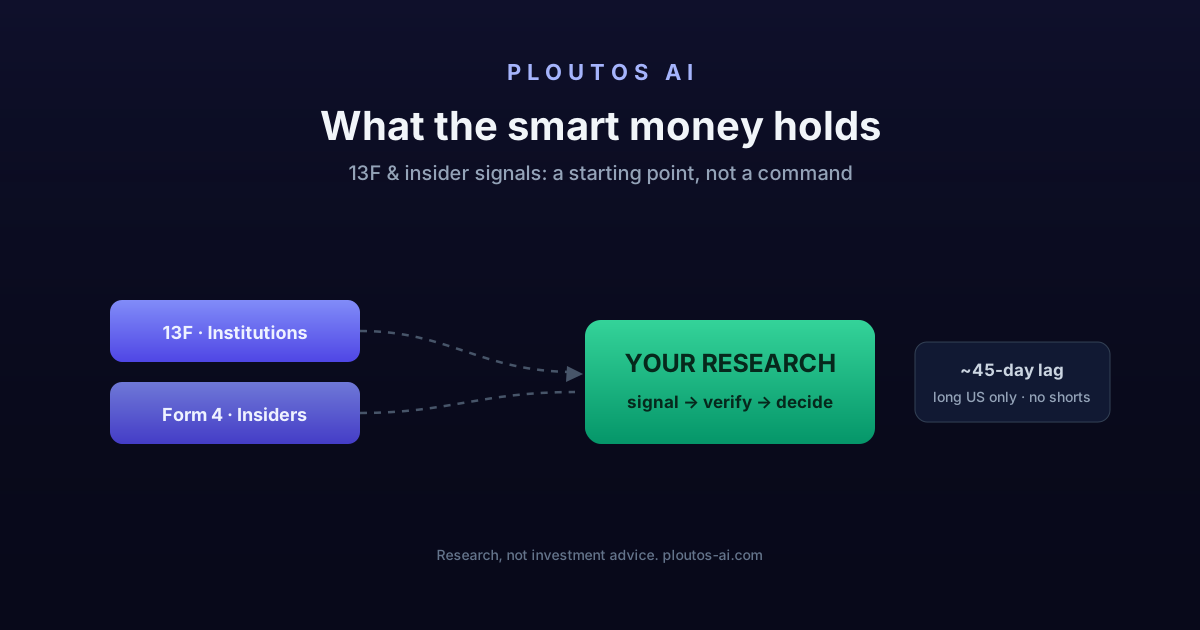
"Smart money." The phrase promises that if you can see what the big institutional investors are buying, you can simply follow them. It is an appealing idea, and largely wrong. The data is real and public, but what it means, and especially what it doesn't mean, is more subtle than the title of a "See what Buffett bought" video suggests.
This article explains what 13F filings and insider signals really are, what you can and cannot conclude from them, and how to use them as a research tool, never as a command.
What 13F filings are (and why they exist)
In the US, every institutional manager with more than $100 million in US equities is required by the SEC to publish, each quarter, what they hold. That filing is the Form 13F. It is the reason you can, entirely free and legally, see the portfolios of Warren Buffett's Berkshire Hathaway, Pershing Square, Baupost and dozens of others.
The purpose is transparency: the market should know where large institutional capital is accumulating. For the individual investor, it is a rare window into the moves of people with research teams and access you do not have. The problem is not the data. It is how most people read it.
What they tell you, and what they DON'T
13F filings have three serious limits that "see what X bought" videos rarely mention:
1. They are delayed up to ~45 days. A manager reports what they held at the end of the quarter, but has up to 45 days to publish it. By the time you see it, the information can be three or four months old, and the manager may already have sold.
2. They show only long, US positions. You do not see shorts, you do not see most options positions, you do not see cash, bonds or foreign stocks. You see half the picture. A fund can hold a stock long and have hedged it with positions that simply never appear in the 13F.
3. Herd risk. Ten famous funds holding the same stock does not mean they are right; it means they think alike. The most dangerous trade is often the one all the "smart" money has already made, because the market has already priced it in.
And the most important limit is conceptual: "a big fund holds it" is not a reason to buy. You do not know the price they paid, how large the position is as a share of their portfolio, the time horizon, or the role it plays in their overall strategy. You are copying a move without knowing its reasoning, and the reasoning is the entire value.
Insiders (Form 4): a cleaner signal?
There is a second kind of signal many consider more reliable: insiders. When an officer (CEO, CFO, board member) buys or sells their own company's stock, they report it to the SEC on a Form 4, usually within two business days, so it is far fresher than a 13F.
The logic: nobody knows a company better than the people running it. When they put their own money down buying in the open market (not through options grants), it is a vote of confidence with real cost behind it.
But here too, be careful: insiders sell for a thousand reasons (taxes, diversification, buying a house) that say nothing about the company, while they mostly buy for one. That is why insider buying, especially "cluster buying" by several officers at once, is more interesting than selling. It remains a signal, not proof.
How to read them properly
The right way to use smart-money data is not as a shopping list to copy, but as:
- An idea source. "Why did three value funds enter this sector this year?" is a good prompt to start your own research.
- Confirmation or challenge. If you have already done the work and find that experienced, long-horizon investors hold the same name, that adds a little confidence. If you find everyone leaving, it is worth asking why.
- Never a command. The signal is the start of research, not the end of it.
The move from "Buffett holds it" to "I understand why, and I agree with the reasoning" is the whole job. What you skip in that move is exactly your risk.
How Ploutos uses it
At Ploutos, smart-money data is one lens among many, not the driver. In every analysis we track whether any of 12 legendary investors holds the stock via 13F, and whether there is recent insider buying via Form 4, flagging explicitly when cluster buying occurs.
But, crucially, it sits next to the fundamentals, the valuation and, above all, the Devil's Advocate, which actively builds the counter-argument: why the "smart money" might be wrong here, what could go wrong, what the bear case is. You will never see "X holds it, so buy." You will see "X holds it, here is what that means, and here is why it may not matter for your situation."
To see how it fits the whole picture, read how Ploutos analyzes a stock, or how we weigh quality through the economic moat.
A starting point, not a shortcut
13F and insider signals are among the most underrated free tools for the individual investor, and at the same time among the most misused. Read correctly, they give you ideas and context. Read badly, they make you copy moves you do not understand, late and without the hedge that may accompany them.
Their value is not to tell you what to buy. It is to show you where to start looking. You can see smart-money signals fold into a full analysis if you run one, or see stocks that stand out on the Market Radar.
Frequently asked questions
What is a Form 13F?
It is the quarterly SEC filing that requires every institutional manager with more than $100 million in US equities to disclose what they hold. It is public and free, which is why you can see the portfolios of funds like Berkshire Hathaway.
Can I just buy whatever Buffett buys?
No. 13F filings are delayed up to 45 days, show only long US positions (not shorts or hedges), and never tell you the price paid or the time horizon. They are a signal to research, not a buy command.
How are insider filings (Form 4) different from 13F?
Form 4 filings are made by company officers (CEO/CFO/board) on trades in their own company's stock, usually within two business days, so they are far fresher. Insider buying, especially by several officers at once, is a more interesting signal than selling.
Is smart money reliable in the end?
It is useful as an idea source and as confirmation after your own research, not as proof. Watch the herd risk: if all the smart money already holds something, the market may have already priced it in.
Related reading
- How to read a 10-KWhat a 10-K is, where to find it, which parts to read first and what to look for in each. A guide to the annual filing US companies make with the SEC.
- Insider trades and Form 4: what they meanWhat Form 4 is, who counts as an insider, how to tell a real purchase from stock pay, and why an executive's sale usually says less than a purchase.
- ROIC and ROE: what they show and how they differReturn on invested capital (ROIC) and return on equity (ROE) explained simply: how they are calculated, why ROE is flattered by debt, and why ROIC says more about the quality of a business.
Important notice
This article is for general educational and informational purposes only. It is not investment advice and does not take into account your personal circumstances, objectives, or financial situation. Any security named is described for illustration and is not a recommendation to buy or sell.
Investing in stocks carries risk, including the possible loss of all invested capital. The past performance of any analysis, methodology, or strategy is not a reliable indicator of future results. Different investors reach different conclusions from the same information, depending on their objectives, time horizon, and risk tolerance.
You are solely responsible for your investment decisions. Before acting on any information from this site, you should assess whether it is appropriate for your circumstances and consult an appropriately qualified professional if you are in any doubt.
See the Terms for the full disclaimer and disclosures.
Try Ploutos AI on a ticker you're researching
Free tier includes 3 deep analyses per month. No credit card required.
Get started, it's free