Fundamental analysis of stocks: a guide to valuing a company
What fundamental analysis is, how it differs from technical analysis, and the 3 steps to evaluate a stock: the business, the financials, and the valuation.
Research, not advice. This guide is educational. It explains a methodology and is not a recommendation to buy or sell any security. Full disclosure at the end.
A stock's price changes every second. The value of the business behind it changes far more slowly. Fundamental analysis is the attempt to answer the second, more important question: what is this business actually worth, regardless of what the market is saying today?
This guide explains what fundamental analysis is, how it differs from technical analysis, and the three steps in which you can evaluate a stock. It is the starting point; each step links to a deeper article if you want to dig in.
What fundamental analysis is (and isn't)
There are two broad schools in stock analysis. Technical analysis studies price and volume on charts, looking for patterns that supposedly predict the next move. Fundamental analysis does almost the opposite: it largely ignores price and looks at the business itself. How much it earns, how much cash it generates, how much debt it carries, how fast it grows, and whether it has something protecting it from competition.
The goal is not to guess tomorrow's price. It is to estimate a fair value for the company and compare it with what the market is asking. When the price is well below the estimated value, there is a margin of safety. When it is above, you may be paying up for optimism. The whole discipline of value investing lives in that gap between price and value.
The skeleton: three questions
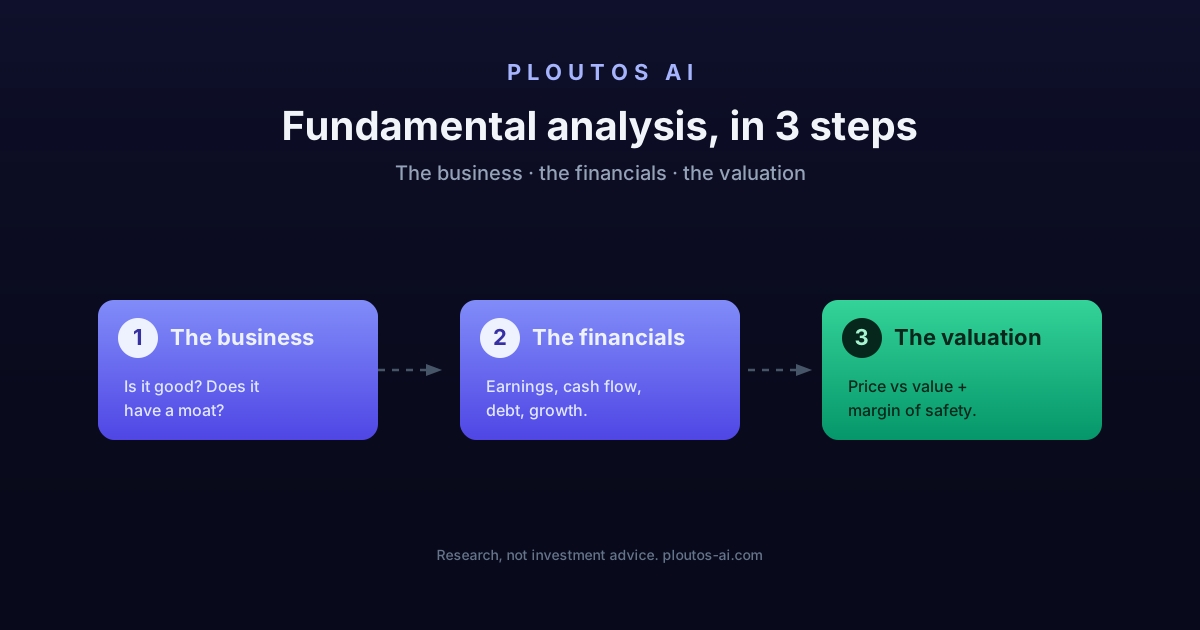
Every fundamental analysis, however complex it gets, essentially answers three questions in this order:
- Is it a good business? (what it does, how it makes money, whether it has a competitive advantage)
- Is it financially healthy? (earnings, cash flows, debt, growth)
- Is it reasonably priced? (valuation and margin of safety)
If it fails one of the three, you usually do not need to proceed to the rest. Let's take them one at a time.
Step 1: Understand the business
Before you touch a number, you should be able to explain in one sentence what the company does and how it makes money. If you cannot, you are not ready to evaluate it, no matter how much analysis you read.
Then you ask the most important qualitative question: what protects it? An excellent company with no defensive character attracts competitors who erode its profits. A durable competitive advantage, what is called an economic moat, is the reason a company can keep high returns for years instead of losing them.
Step 2: Read the financials
This is where the numbers come in, and the good news is you do not need to read all of them. Three financial statements tell almost the whole story: the income statement (revenue and earnings), the balance sheet (what it owns and owes), and the cash flow statement (the real cash coming in and out).
From these come a few quality metrics that actually matter: profit margins, return on capital, debt relative to earnings, and revenue growth over time. The full, step-by-step way to read them without being an accountant is in how to read a stock's fundamentals.
Step 3: Valuation — price versus value
A good company is not automatically a good investment; it depends on the price you pay. Valuation is the attempt to put a number on fair value. The best-known method is discounted cash flow (DCF), which estimates value from the company's future cash, but it is fragile and so is combined with others.
The key is not a precise number, but the margin of safety: the distance between price and estimated value that protects you when some of your assumptions turn out wrong. But be careful: a cheap price does not automatically mean an opportunity. The difference between a genuinely undervalued stock and a value trap is exactly whether the fundamentals justify the low price or warn about it.
Beyond the numbers: catalysts, smart money and risks
Fundamental analysis does not end at the accounting. Two more lenses add context. The first is catalysts: what could change the story (earnings, management changes, industry developments). The second is smart money: what institutional investors and insiders hold, a signal that, read correctly, works as a prompt for research and not as a command. The way to use it without getting trapped is explained in smart money & 13F.
And the most underrated lens: the bear case. Before you conclude, deliberately ask what could go wrong. An analysis that has not considered how it would lose money is not an analysis, it is a wish list.
How much time, and how not to give up
The reason most individual investors do not do fundamental analysis is not that it is conceptually hard, but that it is time-consuming: gathering and interpreting data eats the hours, not the decision itself. That is exactly where most attempts stop.
That is the problem Ploutos solves: it compresses data gathering, a sector-aware valuation ensemble, smart-money signals and the Devil's Advocate into minutes, from verifiable official sources, and leaves the decision to you. See how it analyzes a stock step by step, or run an analysis on a company you care about.
Where to start
Don't try to analyze everything. Pick one company you understand, give it an hour, and walk through the three questions: is it a good business, is it healthy, is it reasonably priced? Your first analysis will be slow and incomplete. Your tenth will be routine. That is how judgment is built, and judgment is the one thing no tool can replace.
Frequently asked questions
What is fundamental analysis?
It is the method of evaluating a stock through the underlying business: earnings, cash flows, debt, growth and competitive advantage. The goal is to estimate the company's fair value and compare it with the market price.
What is the difference between fundamental and technical analysis?
Technical analysis studies price and charts to predict short-term movement. Fundamental analysis largely ignores price and asks what the business is actually worth. They are tools for different questions and time horizons.
How long does fundamental analysis of a stock take?
A careful analysis can take anywhere from an hour to several days, depending on depth. Most of the time goes into gathering and interpreting data, not the decision itself.
Do I need accounting knowledge?
Nothing specialised. You need to understand a few basic concepts (revenue, earnings, cash flow, debt, a few ratios). The guide below and the linked articles explain them in plain language.
Related reading
- How to read a 10-KWhat a 10-K is, where to find it, which parts to read first and what to look for in each. A guide to the annual filing US companies make with the SEC.
- Insider trades and Form 4: what they meanWhat Form 4 is, who counts as an insider, how to tell a real purchase from stock pay, and why an executive's sale usually says less than a purchase.
- ROIC and ROE: what they show and how they differReturn on invested capital (ROIC) and return on equity (ROE) explained simply: how they are calculated, why ROE is flattered by debt, and why ROIC says more about the quality of a business.
Important notice
This article is for general educational and informational purposes only. It is not investment advice and does not take into account your personal circumstances, objectives, or financial situation. Any security named is described for illustration and is not a recommendation to buy or sell.
Investing in stocks carries risk, including the possible loss of all invested capital. The past performance of any analysis, methodology, or strategy is not a reliable indicator of future results. Different investors reach different conclusions from the same information, depending on their objectives, time horizon, and risk tolerance.
You are solely responsible for your investment decisions. Before acting on any information from this site, you should assess whether it is appropriate for your circumstances and consult an appropriately qualified professional if you are in any doubt.
See the Terms for the full disclaimer and disclosures.
Try Ploutos AI on a ticker you're researching
Free tier includes 3 deep analyses per month. No credit card required.
Get started, it's free