What is a stock split, and does it change what your shares are worth?
A stock split multiplies your share count and divides the price by the same amount. Here is what actually changes, what does not, and the one thing worth checking afterward.
Research, not advice. This guide is educational. It explains a methodology and is not a recommendation to buy or sell any security. Full disclosure at the end.
You check your portfolio and the price of a stock you own just dropped 90% overnight. Your first instinct is panic. Then you notice your share count went up by the same proportion, and the actual value of your position did not move at all. What you just watched happen was a stock split, and it is one of the most misunderstood events in investing precisely because the headline number moves so dramatically while nothing of substance changes underneath it.
What actually happens
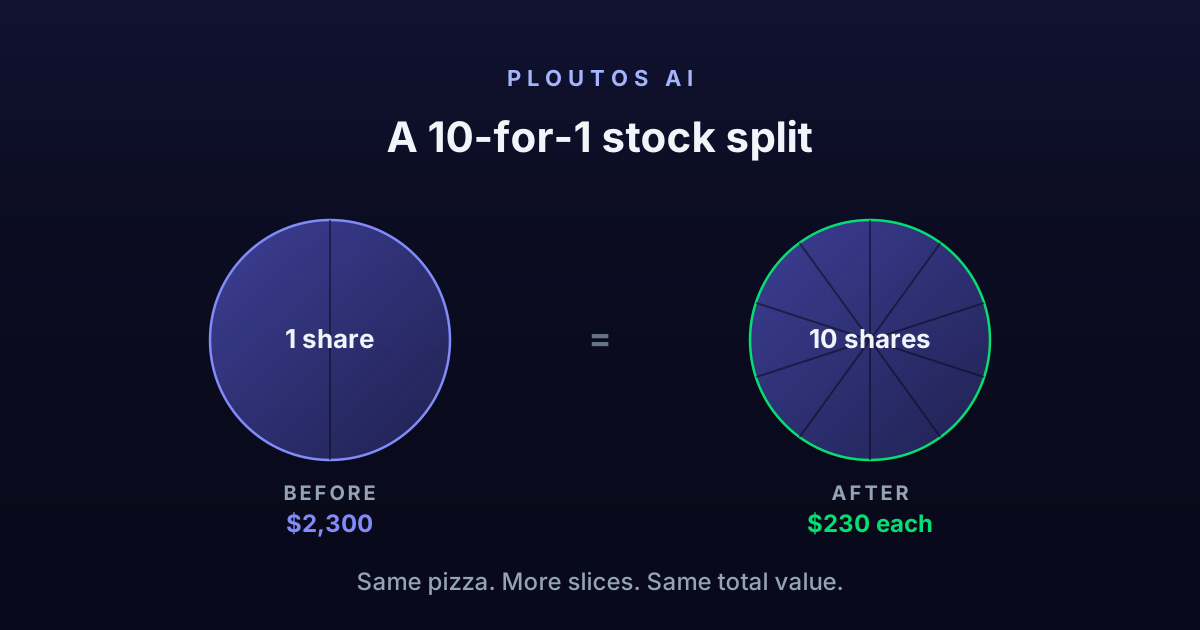
A stock split is a company dividing each existing share into a larger number of new shares. A common example is a 10 for 1 split. If you owned 1 share worth $2,300 before the split, you own 10 shares worth $230 each right after it. Multiply it out and you get the same $2,300 either way.
Nothing about the company changed at the moment of the split. Not its revenue, not its profits, not its assets, not the percentage of the company you own. The only thing that changed is how that same ownership stake is sliced up on paper. Same pizza, more slices, same total value.
What does not change
- The value of your position. Ten shares at $230 is worth exactly what one share at $2,300 was worth.
- Your ownership percentage. You still own the same fraction of the company as before.
- The company's fundamentals. Revenue, margins, debt, competitive position, none of it is touched by a split.
- The underlying valuation. If the stock was fairly valued, overvalued, or undervalued before the split, it is exactly as fairly valued, overvalued, or undervalued right after it, once you adjust the numbers for the new share count.
What does change
- The share count, obviously, since that is the entire mechanism.
- The price per share, in exact inverse proportion to the share count.
- Per-share metrics like earnings per share. If a company earned $10 per share before a 10 for 1 split, it earns $1 per share right after, on the same total profit spread across ten times as many shares.
- Accessibility and liquidity, which is the real, practical reason companies do this. A $230 share price is easier for a retail investor to buy in round lots than a $2,300 one, and a lower per-share price tends to widen the pool of potential buyers and increase trading volume.
Why companies actually split their stock
There is no legal or financial requirement to split a stock, and plenty of well known companies never do it, keeping share prices in the thousands of dollars on purpose. The usual reasons a company chooses to split instead:
- Keeping the share price in a range that feels approachable to individual investors, since a high sticker price can (irrationally, but in practice) discourage smaller buyers.
- Supporting liquidity and tighter bid ask spreads by increasing the number of shares available to trade.
- Sometimes signaling management's confidence that the higher price will hold or keep climbing, though this is a soft signal at best, not a fundamental one.
None of these reasons involve the business becoming worth more. A split is a cosmetic, mechanical adjustment, not a value creation event.
The myth worth retiring
The mistake people make most often is treating a split as if it made a stock cheaper, and therefore a better buy. It did not. A $2,300 stock that splits 10 for 1 and becomes a $230 stock is exactly as expensive, relative to the business behind it, as it was the day before. If it was trading above fair value at $2,300, the split version at $230 is trading above the equivalent, split adjusted fair value too. The lower sticker price does nothing to change that math, it just changes the denominator.
The only thing a split genuinely earns you is a lower barrier to buying a smaller dollar amount, and slightly better liquidity. If you are deciding whether a stock is a good investment, the split itself is not evidence either way, you still have to answer the real question: is the price, whatever it happens to be denominated in today, low or high relative to what the business is actually worth.
One detail that matters more than it should: historical financial data needs to be adjusted for every split a company has ever done, or ratios like earnings per share and price to earnings end up compared against numbers from a different share count entirely, quietly corrupting the analysis. It is a small, boring detail, and it is exactly the kind of thing that is easy to get wrong by hand and easy to automate correctly. If you want to see how a full valuation and the rest of the research come together once splits, and everything else, are accounted for, you can run an analysis or read the full pipeline.
Frequently asked questions
What is a stock split?
A company dividing each existing share into multiple new shares, without changing the total value of what shareholders own.
Does a stock split make a stock cheaper or more valuable?
Neither. The price per share drops in the same proportion the share count rises, so the total value of your position is unchanged.
Why do companies do stock splits?
Mostly to keep the per-share price approachable for individual investors and to support liquidity, not because anything about the business changed.
Does a split affect whether a stock looks cheap or expensive?
No. Per-share numbers like earnings and fair value scale down by the same factor as the price, so the underlying valuation is unchanged.
Related reading
- How to read a 10-KWhat a 10-K is, where to find it, which parts to read first and what to look for in each. A guide to the annual filing US companies make with the SEC.
- Insider trades and Form 4: what they meanWhat Form 4 is, who counts as an insider, how to tell a real purchase from stock pay, and why an executive's sale usually says less than a purchase.
- ROIC and ROE: what they show and how they differReturn on invested capital (ROIC) and return on equity (ROE) explained simply: how they are calculated, why ROE is flattered by debt, and why ROIC says more about the quality of a business.
Important notice
This article is for general educational and informational purposes only. It is not investment advice and does not take into account your personal circumstances, objectives, or financial situation. Any security named is described for illustration and is not a recommendation to buy or sell.
Investing in stocks carries risk, including the possible loss of all invested capital. The past performance of any analysis, methodology, or strategy is not a reliable indicator of future results. Different investors reach different conclusions from the same information, depending on their objectives, time horizon, and risk tolerance.
You are solely responsible for your investment decisions. Before acting on any information from this site, you should assess whether it is appropriate for your circumstances and consult an appropriately qualified professional if you are in any doubt.
See the Terms for the full disclaimer and disclosures.
Try Ploutos AI on a ticker you're researching
Free tier includes 3 deep analyses per month. No credit card required.
Get started, it's free