How to tell if a stock is overvalued: the signs that actually matter
A high price doesn't make a stock overvalued. Learn the real signs: valuation multiples, the growth already priced in, and when a great company is still a bad price.
Research, not advice. This guide is educational. It explains a methodology and is not a recommendation to buy or sell any security. Full disclosure at the end.
It is tempting to judge a stock by its price tag. A share at 800 feels expensive; a share at 4 feels cheap. But the number on the screen says almost nothing about whether a stock is overvalued. A company at 800 can be a bargain and one at 4 can be wildly expensive. Overvaluation is not about the price — it is about the price relative to what the business is worth.
This article explains what overvalued actually means, the signs that genuinely matter, and the trap that catches even careful investors: confusing a great company with a great price.
Overvalued means price above value, not price above zero
Every business is, in the end, a machine for producing cash over time. The intrinsic value of a stock is what that future cash is reasonably worth today (see our piece on DCF valuation for how that translation works). A stock is overvalued when its market price sits meaningfully above that intrinsic value, and undervalued when it sits below it, leaving a margin of safety.
So the price tag is the wrong starting point. The right question is always: what is the business worth, and what am I being asked to pay for it? Everything below is a way of approaching that one question.
Sign 1: the valuation multiple is high relative to the growth that justifies it
The fastest sanity check is a valuation multiple — most commonly price-to-earnings (P/E), or price-to-sales (P/S) for companies that don't yet earn much. A multiple compresses "price relative to what the company produces" into a single number.
But a high multiple is not the same as overvalued. A high P/E simply means the market expects strong future growth. The real test is whether the business can plausibly deliver the growth the multiple already assumes. A company growing earnings 40% a year may fully deserve a P/E that would be absurd for one growing at 3%. Overvaluation appears when the multiple demands a future the business is unlikely to produce.
A useful habit: instead of asking "is this multiple high?", ask "what would have to be true for this multiple to make sense?" If the answer requires near-flawless execution for a decade, the expectations — not the company — are the risk.
Sign 2: the price already has years of good news baked in
This is the heart of overvaluation. When a stock has run up on a strong story, the optimism becomes the price. From there, even good results can disappoint, because the bar that was set is so high.
The mental move is to separate the business from the expectations priced into it. Ask: how much growth, for how many years, at what margins, is this price assuming? When those assumptions start to sound heroic — a small company growing into a number larger than entire mature industries — you are likely looking at expectations that leave no room for error.
Sign 3: a great company at any price
The most expensive mistake in investing is believing that a wonderful business is automatically a wonderful investment. It is not. Price decides the return.
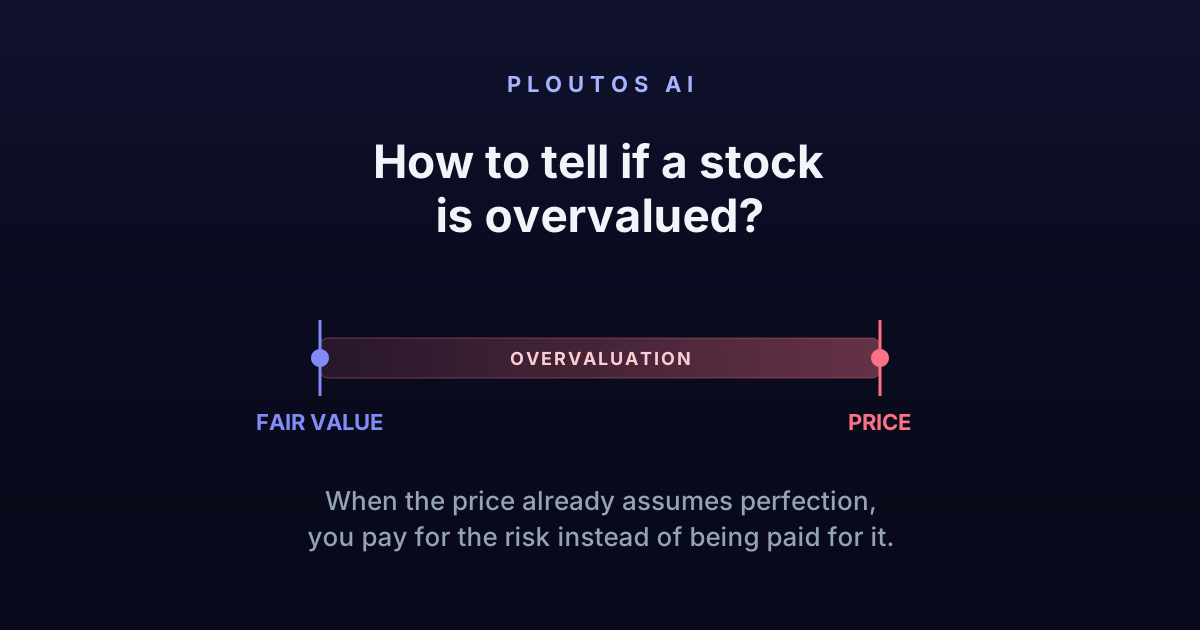
A dominant company with a wide economic moat can keep growing, keep winning, keep doing everything right — and still be a poor stock if you overpaid at the start. The company succeeds; the expectations baked into your entry price do not. "Overvalued" is simply the gap between an excellent business and a price that already assumes perfection.
How to check it sensibly (without pretending to be precise)
Valuation is a range, not a verdict. A disciplined process does not produce a single magic "fair price" — it produces a reasonable range and a sense of how much optimism the current price requires. A few practical steps:
- Compare price to value, never price to itself. Estimate what the business is worth, then look at the gap. The share price in isolation is noise.
- Stress-test the assumptions. Change the growth rate and margins a little and watch what happens to the value. If the case only works in the best scenario, the price is fragile.
- Look for the argument against. Before trusting any bullish case, find the strongest reason it could be wrong. A view that has survived its own counter-argument is worth far more than one that hasn't.
- Treat any "target price" with suspicion. Targets depend on assumptions that may not play out; a small change moves them a lot.
How Ploutos approaches this
Ploutos is built around exactly this discipline. Every analysis pairs the bullish reasoning with a deliberate Devil's Advocate — the strongest case against the idea — so the optimism in a price is tested rather than taken for granted. It works from real filings, frames value as a range with its assumptions on the table, and is built to describe what the data shows, not to tell you what to buy. If you want to pressure-test the expectations inside a price yourself, you can run an analysis on a stock you know well, or read how it fits into the full pipeline.
Overvaluation is never about the size of the price tag. It is about how much has to go right to justify it — and whether you are being paid to take that risk, or paying for the privilege.
Frequently asked questions
How can you tell if a stock is overvalued?
A stock is overvalued when its market price sits above the intrinsic value of the underlying business — that is, above what the company's future cash flows are reasonably worth today. A high share price on its own tells you nothing; the question is price relative to value, usually examined through valuation multiples and the growth those multiples already assume.
Does a high P/E ratio mean a stock is overvalued?
Not by itself. A high price-to-earnings ratio means the market expects strong future growth. It is overvalued only if the business cannot plausibly deliver the growth the multiple implies. A fast-growing company can deserve a high P/E; a slow-growing one with the same P/E may not.
Can a great company still be an overvalued stock?
Yes. A great business and a great investment are not the same thing. If the price already reflects years of flawless execution, even excellent results can disappoint the expectations baked into the price. The company can keep winning while the stock still falls.
What is the opposite of an overvalued stock?
An undervalued stock, where the price sits below intrinsic value, leaving a margin of safety. The same discipline — comparing price to value rather than judging the price tag itself — applies in both directions.
Related reading
- How to read a 10-KWhat a 10-K is, where to find it, which parts to read first and what to look for in each. A guide to the annual filing US companies make with the SEC.
- Insider trades and Form 4: what they meanWhat Form 4 is, who counts as an insider, how to tell a real purchase from stock pay, and why an executive's sale usually says less than a purchase.
- ROIC and ROE: what they show and how they differReturn on invested capital (ROIC) and return on equity (ROE) explained simply: how they are calculated, why ROE is flattered by debt, and why ROIC says more about the quality of a business.
Important notice
This article is for general educational and informational purposes only. It is not investment advice and does not take into account your personal circumstances, objectives, or financial situation. Any security named is described for illustration and is not a recommendation to buy or sell.
Investing in stocks carries risk, including the possible loss of all invested capital. The past performance of any analysis, methodology, or strategy is not a reliable indicator of future results. Different investors reach different conclusions from the same information, depending on their objectives, time horizon, and risk tolerance.
You are solely responsible for your investment decisions. Before acting on any information from this site, you should assess whether it is appropriate for your circumstances and consult an appropriately qualified professional if you are in any doubt.
See the Terms for the full disclaimer and disclosures.
Try Ploutos AI on a ticker you're researching
Free tier includes 3 deep analyses per month. No credit card required.
Get started, it's free